


Programming has grown into a large collection of languages, each created with specific goals in mind. Dart is one of the newer ones that has earned its place by balancing productivity with a system that’s both flexible and efficient. Google introduced it in 2011, and over the years it has matured into a language that runs well on both client and server. Many people first encounter it through Flutter, the framework for building mobile apps, but Dart itself is a general-purpose language capable of working across several domains.
The Foundation of Dart
Every language is built on a set of decisions that affect how it behaves during development and execution. Dart’s foundation rests on its type system, the way it compiles, the virtual machine that powers it, and the memory management strategies that keep everything running smoothly.
Static and Dynamic Typing
Dart provides a static type system with the option to relax into dynamic typing where needed. The static side means the compiler checks variable types before the code runs. This catches many issues early and gives the compiler the chance to optimize. On the other hand, dynamic typing through the dynamic keyword gives developers flexibility when the type is not known at compile time.

The compiler treats greeting and value differently. With greeting, the type is locked in, so the compiler can optimize string operations. With value, type checks happen at runtime. This duality is one reason Dart adapts well to both quick prototypes and larger structured projects.
Compilation Model
Dart takes a hybrid path with compilation. During development, code runs on a just-in-time (JIT) compiler that translates Dart into machine code while the program is running. This makes hot reload possible in tools like Flutter, where updated source is injected into the running Dart runtime and the affected functions are recompiled and swapped back in.
When moving toward production, Dart switches to ahead-of-time (AOT) compilation. The compiler generates optimized machine code for the target platform, cutting out the VM’s runtime overhead. This is what allows mobile apps built with Dart to perform smoothly on both Android and iOS devices.

The first command runs through the VM in JIT mode. The second produces a self-contained native executable that includes a small Dart runtime, which means you can run it directly without calling the dart command. This flexibility is a big reason Dart can act as both a rapid development tool and a production-ready language.
Dart VM
At the core of Dart execution sits the Dart Virtual Machine. When running in JIT mode, the VM takes Dart source code, parses it into an intermediate form, and then compiles functions into machine code as they’re called. Hot reload works because the VM can discard compiled versions of functions and recompile them with updated logic while the program keeps running.
The VM also manages isolates, handles scheduling, and provides built-in debugging support. It’s not only an execution engine but also an environment where Dart-specific features are enforced. For developers working with Dart on the server side, the VM provides the same kind of experience as a traditional runtime like the JVM or CLR but tailored to Dart’s design.

What’s happening behind the scenes is that the VM compiles the loop body into machine instructions and may optimize repeated calls by inlining them or unrolling parts of the loop depending on runtime profiling. The VM adapts dynamically to patterns it detects during execution.
Memory Management
Dart manages memory automatically with a garbage collector designed for short pauses and fast allocation. The collector separates memory into young and old generations. Newly created objects live in the young generation, which is collected more frequently. If an object survives multiple collection cycles, it moves into the old generation.
This strategy is efficient for workloads where many objects are created and discarded quickly, such as UI updates in Flutter.
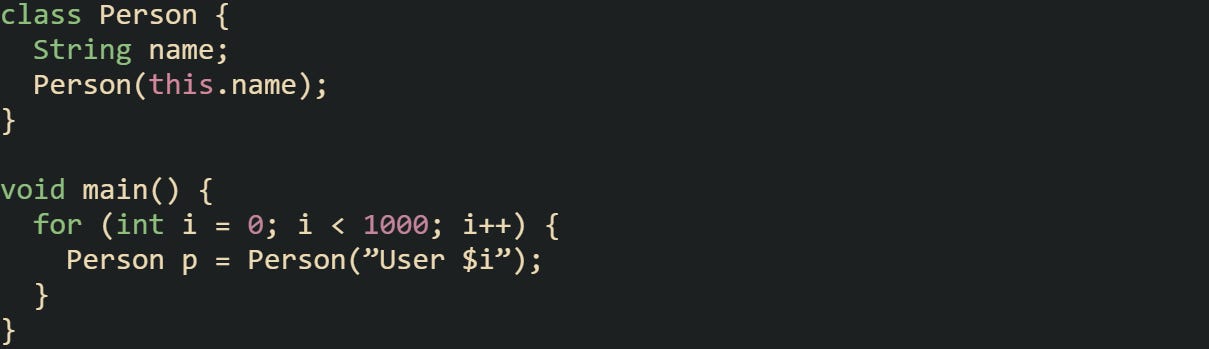
In this loop, thousands of temporary Person objects are created. Most are short-lived and discarded soon after, so they’re collected in the young generation. Only objects that persist over time get promoted. This keeps memory usage steady without requiring manual clean-up.
A subtle aspect of Dart’s memory management is that allocations are very fast. Rather than searching for free blocks of memory, the VM often just moves a pointer forward in a contiguous region, reserving space for the new object. New-space collections use a copying scavenger that compacts the young generation, while old-space collections rely on concurrent mark-sweep and can switch to mark-compact when needed.
Unique Features and Practical Mechanics
Dart has several qualities that set it apart from many other modern languages. These features run deeper than syntax and reach into how code is executed, how developers interact with the runtime, and how Dart connects with its ecosystem. From its handling of asynchronous work to its memory-safe type system, its concurrency model, its package manager, and its link with Flutter, Dart is built to combine performance with a workflow that feels natural.
Asynchronous Programming with Async Await
Asynchronous execution is central to Dart. Instead of freezing the main thread while waiting on a network call or a file read, Dart schedules the work and keeps other operations moving. Futures represent values that will be available later, while Streams represent sequences of values that arrive over time.
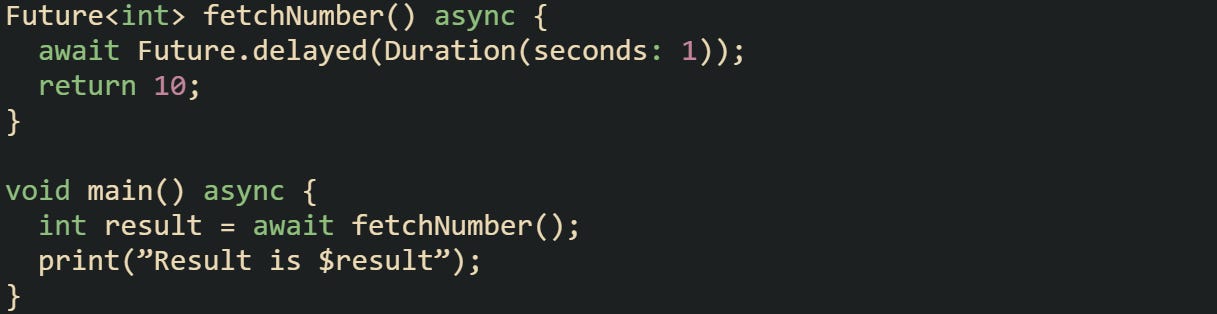
Dart runs an event loop in the main isolate that schedules delayed work and completes it when ready. That lets the main isolate keep running other work instead of blocking.
Streams extend this further by letting functions produce values over and over instead of finishing after a single return.
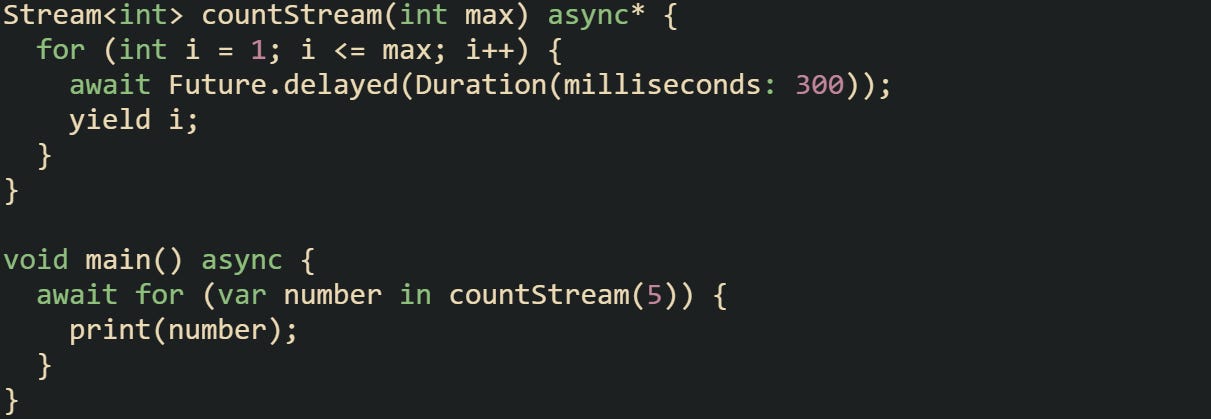
The yield keyword lets values be passed one at a time, which works well in cases where updates happen repeatedly over a period of time.
Isolates for Concurrency
Concurrency in Dart avoids the common issues of shared memory. Instead, Dart uses isolates. Each isolate has its own memory space and can’t directly change objects in another. The way isolates talk to each other is through messages passed with ports.
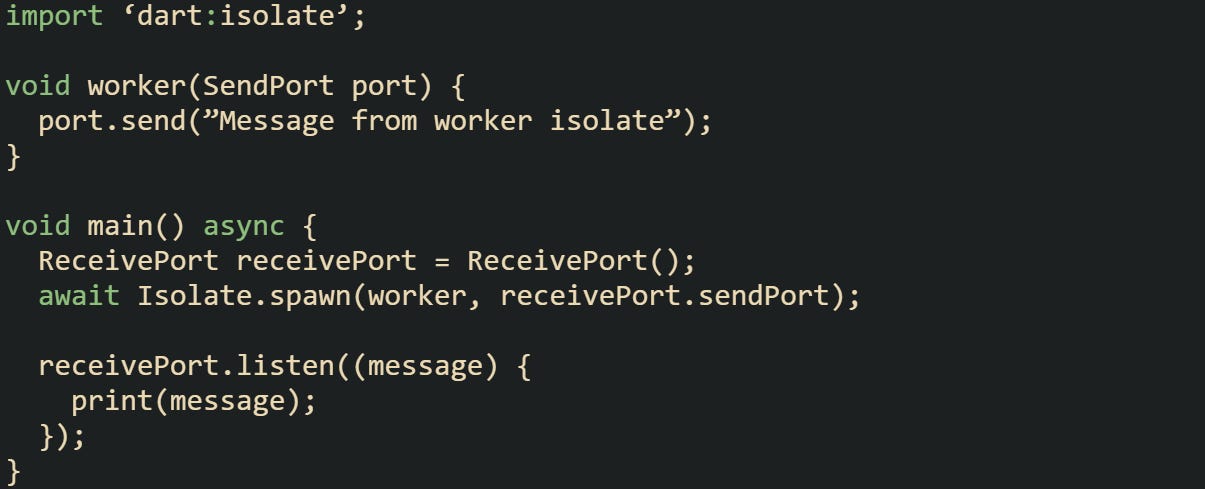
In this case, a worker isolate communicates back to the main isolate with a simple string. The separation of memory between isolates prevents race conditions that occur in systems built on shared state.
Isolates are practical for heavy computations as well. When work like this is placed in a separate isolate, the main thread remains responsive to input.

Running the calculation away from the main isolate allows user-facing parts of an application to keep responding smoothly while the work is processed in the background.
Sound Null Safety
Dart enforces sound null safety, which means a variable has to explicitly declare if it can store a null value. Variables without the ? marker are guaranteed to never be null, and the compiler enforces that at build time.

The compiler checks flows of code to make sure that non-nullable variables are always initialized before they’re used. If a developer forgets to handle a nullable variable, the compiler raises an error instead of letting it slip through to runtime.
Another feature tied to null safety is type promotion. Dart can analyze conditions and promote a nullable type to non-nullable inside certain code blocks, removing the need for repetitive checks.

This makes code easier to write while still being safe.
Package Ecosystem with Tooling
Dart has its own package system run through pub. Libraries are stored on pub.dev, which has grown into the main hub for community and official packages. Developers add dependencies through the pubspec.yaml file.

Running dart pub get fetches the packages and prepares them for use in the project. This system lets developers share solutions and build on top of existing libraries.
Tooling is another strong part of Dart’s ecosystem. dart analyze scans code for errors and style issues, while dart format enforces consistent formatting. Debugging and profiling are built into the Dart SDK, with DevTools providing graphs for memory, performance data, and detailed debugging through a browser. This makes the workflow smoother, from writing code to finding performance issues.
Integration with Flutter
Flutter’s growth has been tightly connected to Dart. Flutter relies on Dart’s hot reload feature, which lets the application update instantly as code changes are made. This is possible because the Dart VM can recompile functions in memory and patch them into the running application without restarting it.
Dart also compiles to native ARM and x64 machine code. Flutter combines this with its rendering engine, Skia, to deliver applications that feel fast across platforms.
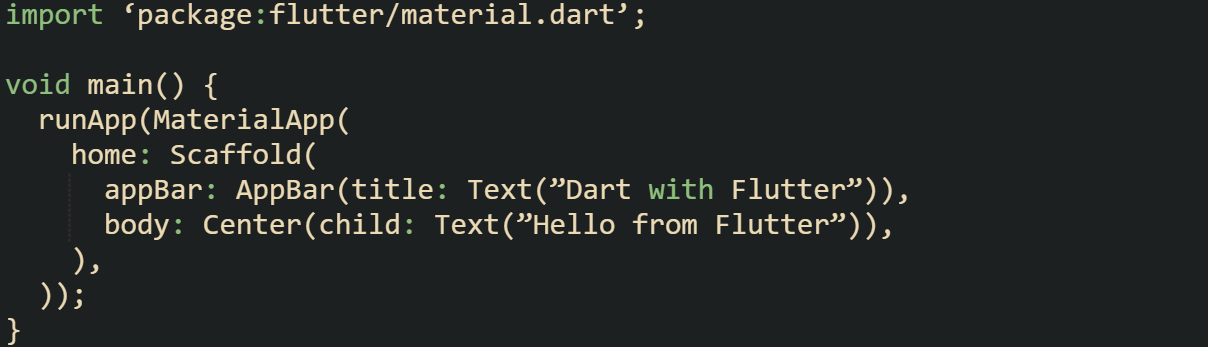
This reflects Flutter’s widget system in action, with Dart as the language driving it. Hot reload during development is possible through the Dart VM, while ahead-of-time compilation produces efficient binaries for mobile and desktop. The combination gives developers fast feedback while coding and strong performance when applications are released.
Conclusion
Dart brings together a type system with sound null safety, a dual compilation strategy, a virtual machine capable of adaptive optimizations, and memory management tuned for short-lived objects. Its event loop, isolates, and asynchronous features provide a safe way to handle concurrent work, while its package manager and tooling strengthen the development workflow. With Flutter as its most visible companion, Dart has proven how these mechanics fit into both fast iteration during development and efficient performance at runtime.