


Creating objects in Dart goes far past the typical constructor seen in many languages. Constructors form the backbone of how instances come to life, deciding how their fields are initialized and how their starting state is built. Dart supports several ways to define these constructors, giving developers fine control over how objects begin their existence. Each form serves a slightly different purpose and helps keep code expressive, efficient, and consistent with intent.
Generative and Named Constructors
Generative constructors handle the direct creation of objects, assigning values to fields when an instance is made. Named constructors extend that process by offering alternative ways to initialize data with clear, descriptive names.
What a Generative Constructor Is
A generative constructor creates a new instance of a class directly. It ties the input arguments to the object’s fields, building everything from the ground up. These constructors share the same name as the class, and Dart lets you keep them compact by listing fields right inside the parameter list.
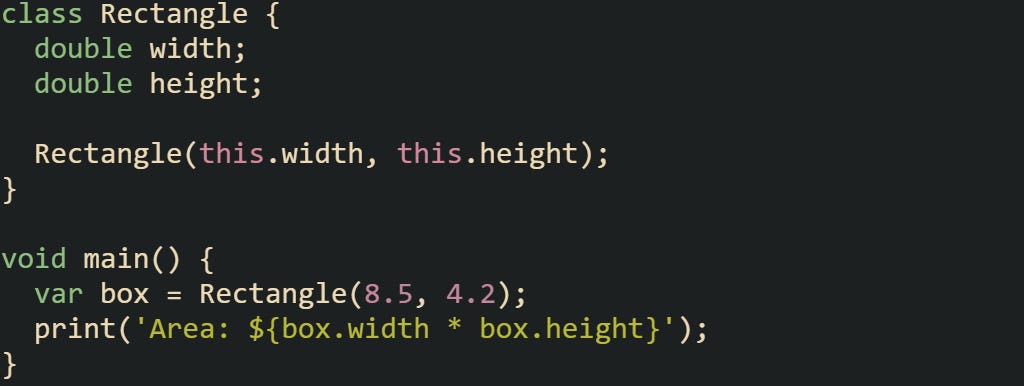
Here we can see the shortest path to create a class that stores a rectangle’s dimensions. The syntax this.width, this.height connects the constructor parameters to the matching fields automatically, saving space and keeping intent clear.
Sometimes initialization calls for a little more logic, such as validating or transforming values before storing them. Dart allows a constructor body to do that easily.
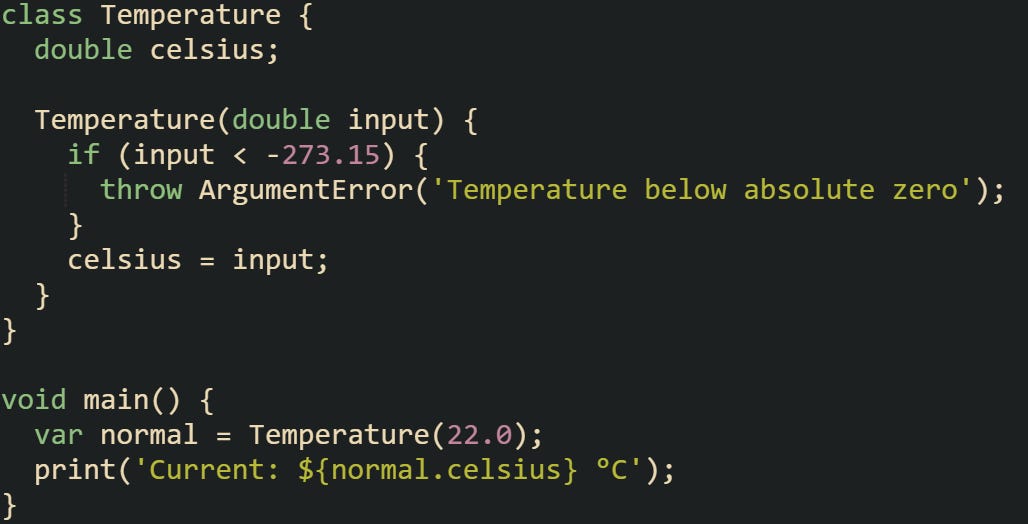
This version uses a body instead of the shorthand style to check an argument before assigning it. That flexibility makes generative constructors practical for enforcing object consistency without resorting to external checks.
Generative constructors can also use an initializer list to prepare values before the body executes. This is helpful when certain fields must be ready at creation.
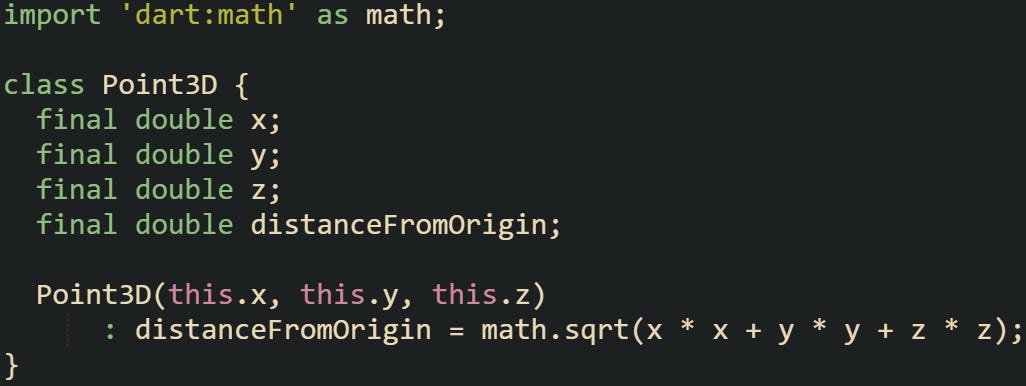
That method sets derived values like distanceFromOrigin right when the object forms, keeping the instance self-contained and efficient from the start.
Named Constructors
Named constructors expand how a class can be built by adding extra entry points for creation. They work as secondary generative constructors that sit alongside the unnamed one. Each gets its own name after a dot, making the purpose of the constructor explicit.
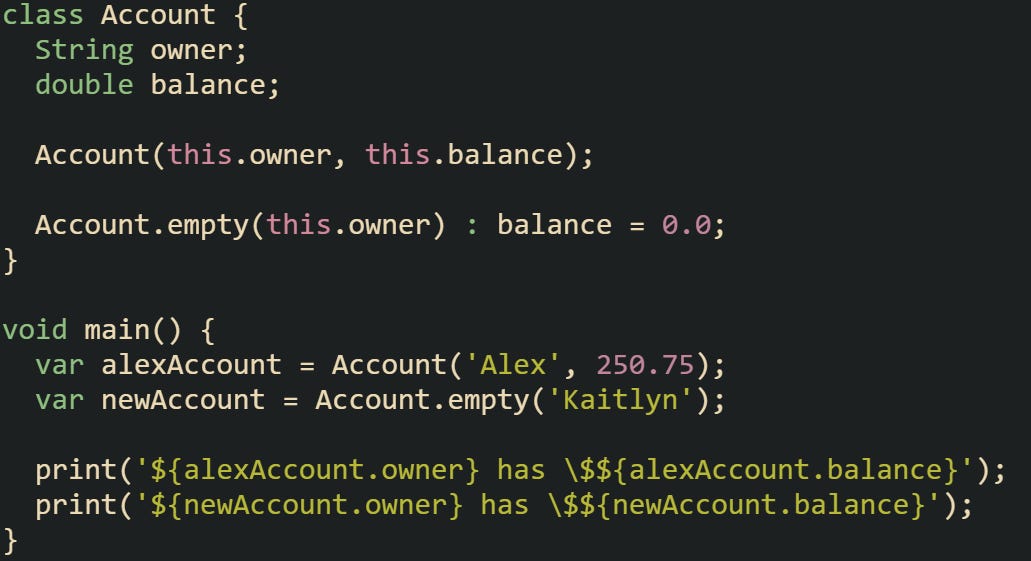
Named constructors such as Account.empty make intent clearer by describing the initialization type right in the call. They also remove the need for extra boolean flags or factory helpers to handle alternate construction paths.
Another case is when a class needs different sources of data for building its instances. A named constructor can handle parsing, conversions, or even loading from structured data like JSON.
![class City { final String name; final int population; City(this.name, this.population); City.fromJson(Map<String, dynamic> data) : name = data['name'], population = data['population']; } void main() { var jsonCity = {'name': 'Eau Claire', 'population': 69000}; var city = City.fromJson(jsonCity); print('${city.name} has ${city.population} residents'); }](https://substackcdn.com/image/fetch/$s_!z7XQ!,f_auto,q_auto:good,fl_progressive:steep/https%3A%2F%2Fsubstack-post-media.s3.amazonaws.com%2Fpublic%2Fimages%2F7e6174da-398e-4fe7-a31f-2408d6dead87_1027x562.png "class City { final String name; final int population; City(this.name, this.population); City.fromJson(Map<String, dynamic> data) : name = data['name'], population = data['population']; } void main() { var jsonCity = {'name': 'Eau Claire', 'population': 69000}; var city = City.fromJson(jsonCity); print('${city.name} has ${city.population} residents'); }")
This pattern keeps deserialization logic close to the type it belongs to, making the code easier to read and maintain.
Redirecting Constructors and Factory Constructors
Not every object in Dart has to start from a blank slate when it’s created. Sometimes one constructor can hand off work to another, or a constructor can decide at runtime which object should be returned. Dart supports both of these situations with redirecting and factory constructors. Redirecting constructors focus on reducing duplication, while factory constructors introduce flexibility and control in how instances are produced.
Redirecting Constructors
A redirecting constructor sends its initialization work to another constructor in the same class instead of handling it directly. This avoids repeating setup logic when multiple constructors share similar initialization paths. The syntax uses this(...) after a colon, with no body allowed.
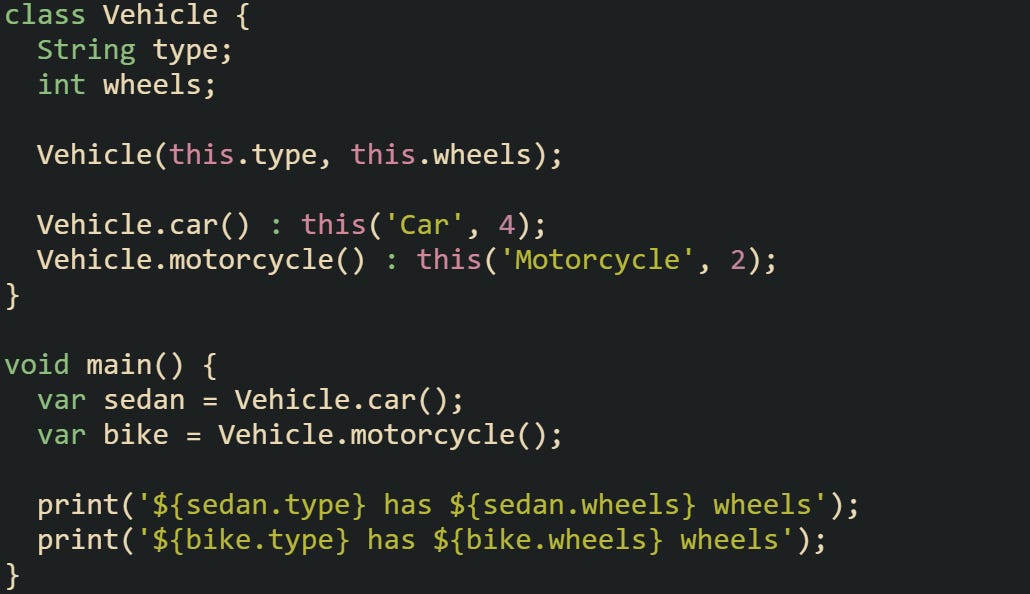
This code keeps object creation consistent across different constructors without duplicating field assignments. The redirect keeps the logic centralized in one place, which makes updates easier later on if class structure changes.
Redirecting constructors can also help when you want different naming conventions or multiple input forms that lead to the same final configuration.
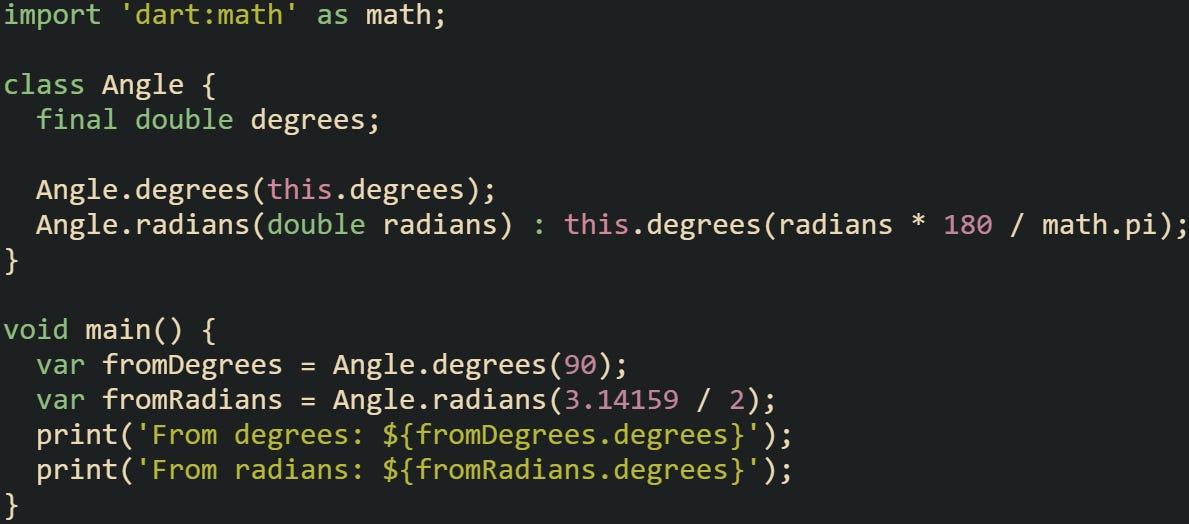
Here, this accepts input in two formats but funnels both through a single initialization path. That keeps the conversion consistent and the code concise. Redirecting constructors are particularly practical in cases where a class represents the same concept in multiple forms, such as measurements, coordinates, or color formats.
Factory Constructors
Factory constructors take a different path altogether. They use the factory keyword and can return any instance that matches the class type, including existing objects or subclasses. Instead of always producing a fresh instance, they decide how construction should happen based on logic inside the constructor body.
A basic use case is caching. If a class represents something that shouldn’t be recreated frequently, a factory constructor can return an already created instance instead.
![class DatabaseConnection { static final Map<String, DatabaseConnection> _cache = {}; final String host; factory DatabaseConnection(String host) { if (_cache.containsKey(host)) { return _cache[host]!; } var connection = DatabaseConnection._internal(host); _cache[host] = connection; return connection; } DatabaseConnection._internal(this.host); } void main() { var first = DatabaseConnection('localhost'); var second = DatabaseConnection('localhost'); print(identical(first, second)); // true }](https://substackcdn.com/image/fetch/$s_!RDfZ!,f_auto,q_auto:good,fl_progressive:steep/https%3A%2F%2Fsubstack-post-media.s3.amazonaws.com%2Fpublic%2Fimages%2Fe6c95fb9-9ee4-4ba8-bbc1-07da81d87ed9_1029x770.png "class DatabaseConnection { static final Map<String, DatabaseConnection> _cache = {}; final String host; factory DatabaseConnection(String host) { if (_cache.containsKey(host)) { return _cache[host]!; } var connection = DatabaseConnection._internal(host); _cache[host] = connection; return connection; } DatabaseConnection._internal(this.host); } void main() { var first = DatabaseConnection('localhost'); var second = DatabaseConnection('localhost'); print(identical(first, second)); // true }")
That keeps every request for the same host tied to one connection, avoiding unnecessary duplication and making resource management more efficient.
A different use for factory constructors is choosing which subclass to instantiate based on runtime information. This is common when multiple types share an interface but the specific type depends on external input.
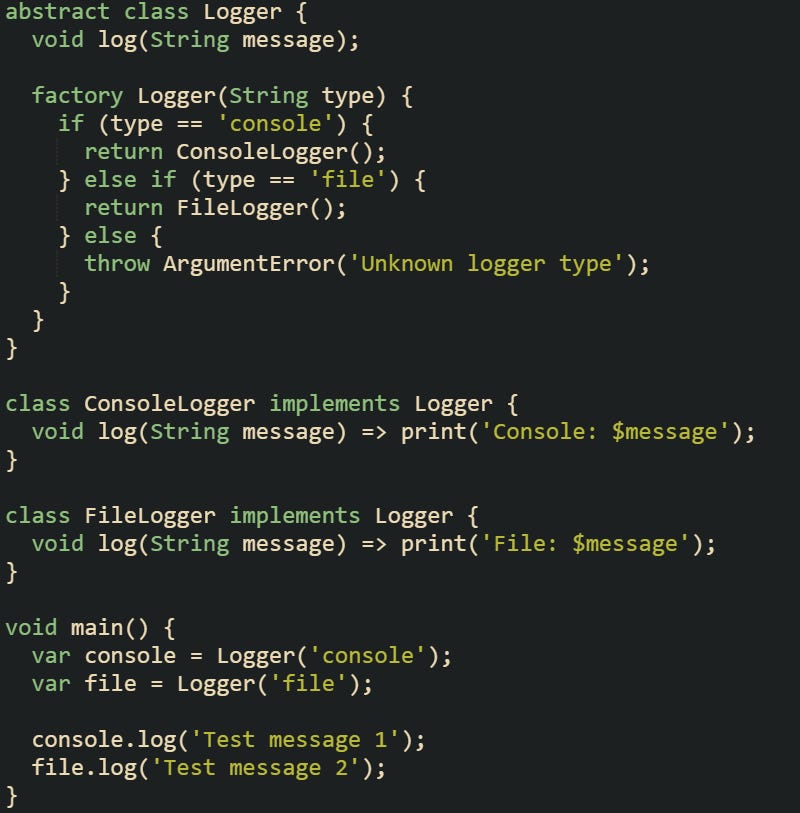
This form of factory constructor allows the calling code to remain simple, while the internal logic chooses which specific implementation is returned. It’s a flexible way to abstract construction details and manage complexity within one class definition.
In null-safe Dart, a factory constructor must return a non-null instance of the class or a subtype. It can’t return null. For fallible creation, throw an error, or use a static method that returns a nullable type or a result wrapper.
When You Pick Redirecting or Factory
Redirecting constructors tend to work best when several constructors within the same class share the same initialization path. They remove repetition and keep setup behavior uniform without altering the actual object being created. Instead of duplicating field assignments across constructors, they simply point the call to one central source of truth. That keeps the class easier to update and maintain when new variations are introduced later.
Factory constructors take a more flexible route by deciding how creation happens. They’re useful when you need control over object reuse, want to build singletons, or must decide between different subclasses at runtime. Because they can contain full function bodies, they can run conditional logic, apply caching strategies, or perform configuration work that regular constructors can’t.
Each of these constructor forms adds its own layer of expressiveness to Dart’s object system. Redirecting constructors focus on reducing internal duplication and keeping logic unified, while factory constructors give developers fine-grained control over what gets returned.
Conclusion
Constructors in Dart define how objects come into existence and how their data is prepared from the start. Generative, named, redirecting, and factory constructors each serve a specific purpose in that process, shaping how initialization unfolds. The mechanics behind them give Dart the flexibility to handle everything from simple object creation to complex instance management. Choosing the right constructor keeps the language expressive and the code aligned with how real applications handle state and structure.