LeetCode’s Reverse Nodes in k-Group problem takes a linked list and asks for sections of k nodes to be flipped at a time. The pattern continues through the list, reversing each complete group while leaving any leftover nodes untouched. It’s a step up from a regular list reversal because it forces you to handle multiple boundaries while keeping the list connected through every change. Small details like how you identify a full group or reconnect the ends make all the difference between a working solution and one that loses track of nodes.
Thinking about this problem in Java means focusing on how references move. Every reversal comes down to carefully managing which node points where and making sure nothing gets lost as links are reassigned. The best mindset is to break the problem into sections that repeat: find a group, reverse it, reconnect it, and move on. When that pattern feels natural, the solution becomes a rhythm of pointer movement rather than a complex problem to untangle.
Given the head of a linked list, reverse the nodes of the list k at a time, and return the modified list.
k is a positive integer and is less than or equal to the length of the linked list. If the number of nodes is not a multiple of k then left-out nodes, in the end, should remain as it is.
You may not alter the values in the list’s nodes, only nodes themselves may be changed.
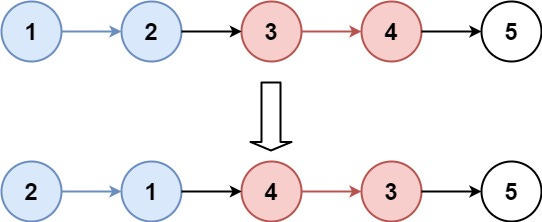
Example 1:
Input: head = [1,2,3,4,5], k = 2
Output: [2,1,4,3,5]
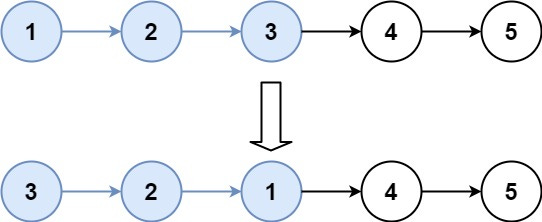
Example 2:
Input: head = [1,2,3,4,5], k = 3
Output: [3,2,1,4,5]
This method uses a stack to reverse nodes in fixed-size groups. Each set of k nodes is pushed onto the stack and then popped to rebuild that section in reverse order before moving to the next. It keeps the logic simple and reads naturally while still following how group reversals work step by step.
Keep reading with a 7-day free trial
Subscribe to Alexander Obregon's Substack to keep reading this post and get 7 days of free access to the full post archives.