


Mixins in Dart let developers share code across several classes without building long inheritance chains. They make it easier to combine behaviors, reuse features, and set rules for where those features belong. Over time, the language has made mixins a central part of its type system, and the modern syntax keeps class relationships predictable. On clauses define mixin application rules, mixin stacking controls method order, and compile-time configuration of mixin combinations influences how inheritance and composition are resolved during compilation.
How Mixins Work
Generally speaking, mixins are one of the most practical ways Dart supports code reuse without leaning on deep inheritance. They let classes borrow functionality from other types without creating a direct subclass relationship. Instead of forming a parent chain, the compiler blends methods and properties from a mixin into a target class during compilation. This lets developers reuse logic without losing flexibility or control of their class hierarchies.
The concept may sound close to inheritance at first, but mixins behave differently. They don’t bring constructors, can’t be instantiated, and don’t force a class to extend them directly. Instead, they contribute functionality in a modular way. This helps Dart maintain single inheritance while still offering the benefits of shared behavior across unrelated classes.
Declaring and Applying a Mixin
A mixin is defined with the mixin keyword, which works like a specialized form of a class. It can hold fields, methods, and getters or setters, but it can’t define constructors. Classes then apply it using the with keyword to gain access to the mixin’s members.
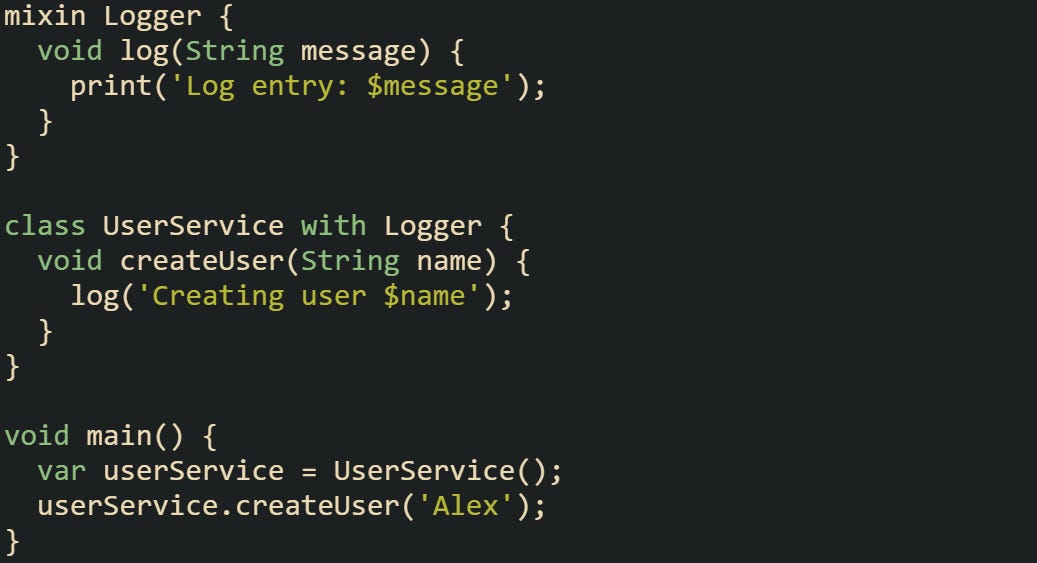
When the compiler processes this code, it copies the log method into UserService. The result acts as though UserService had written the log method itself, but the benefit is that other classes can reuse Logger without inheriting from it directly.
Mixins can also be combined with inheritance, allowing a class to extend one parent and include several mixins.
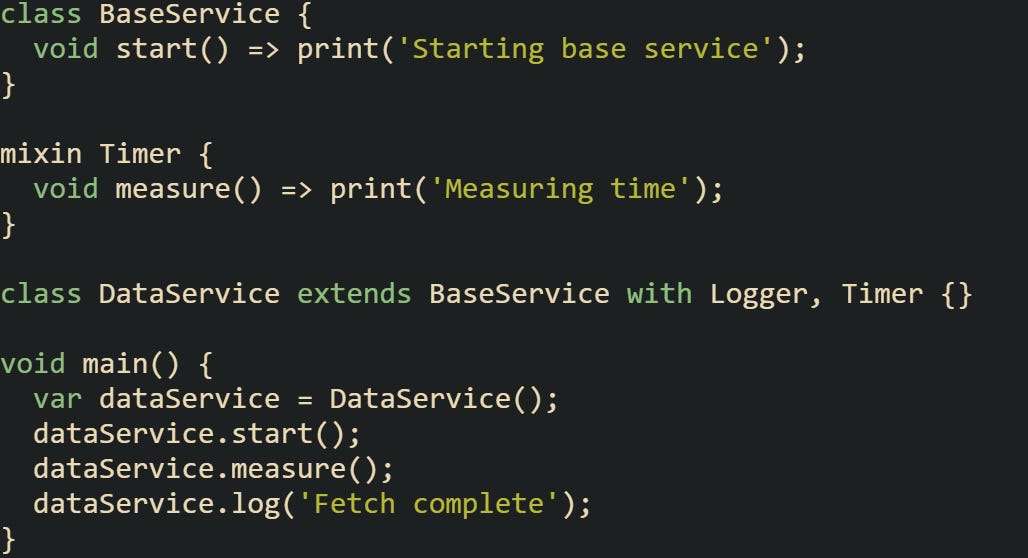
Here, DataService inherits from BaseService but also picks up methods from both Logger and Timer. The with clause applies them in order from left to right. This combination keeps inheritance shallow but flexible enough to build layered behavior in one place.
How the Compiler Merges Mixins
When Dart compiles a class that uses mixins, it creates a temporary synthetic class that combines all the behaviors. Every mixin in the with clause becomes a layer added on top of the previous type. The compiler processes them from left to right, meaning later mixins override earlier ones if they define the same members.
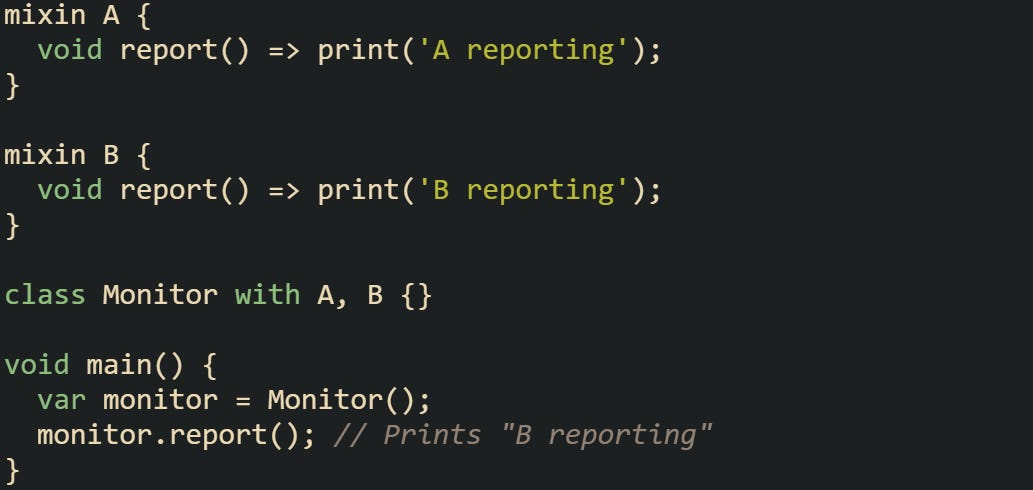
The compiler treats that as if you had written class Monitor = Object with A, B;. The mixin B appears last, so it overrides the version of report in A. This order of application gives predictable behavior when multiple mixins share the same method name.
Mixins can also depend on earlier mixins. For instance, if B needed to call super.report(), Dart treats the previously applied mixin (A) as its superclass during the build process. That structure makes the mixin chain work like a controlled stack of classes.
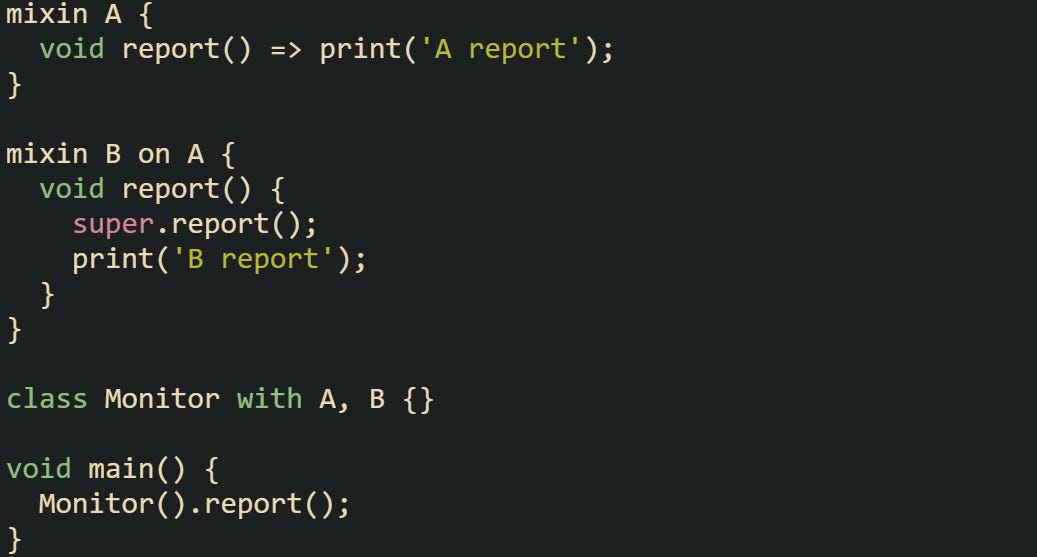
This prints both “A report” and “B report”. The on clause in B lets it call super.report(), giving the compiler the information it needs to order the generated classes correctly. Each layer depends on the next to build a predictable type sequence.
When you use multiple mixins, Dart flattens everything into a single composite type before runtime. This means there’s no runtime penalty for having many mixins, as the compiler has already resolved which methods belong where.
Differences Between Mixins and Abstract Classes
At first, mixins and abstract classes can seem similar because both can define shared methods without being directly instantiated. The difference lies in how they integrate into the inheritance system. Abstract classes form part of the class hierarchy and require subclasses to explicitly extend them. Mixins don’t participate in that chain. They act as an inclusion mechanism rather than a base type.
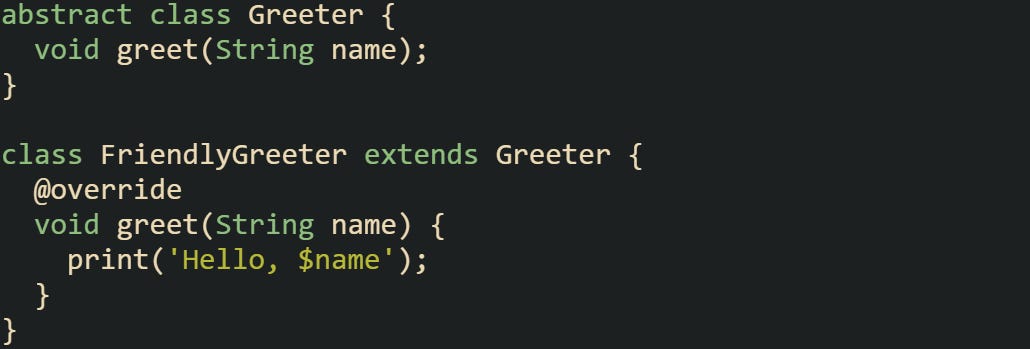
In that code, FriendlyGreeter must extend Greeter, which defines a contract to be fulfilled. That’s inheritance. Mixins, on the other hand, provide reusable logic but don’t enforce that structure.
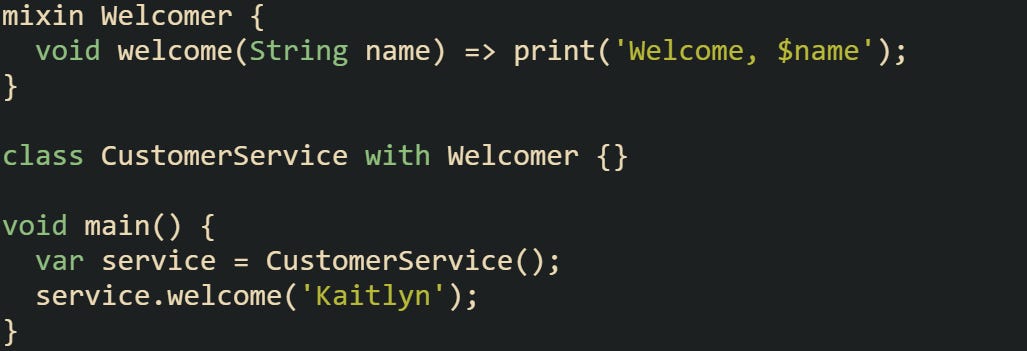
Here, CustomerService includes Welcomer without becoming its subclass. That gives you flexibility to apply Welcomer across unrelated types, something that abstract classes can’t do without breaking hierarchy rules.
An important difference to know is that abstract classes can define constructors and maintain internal state through those constructors, while mixins cannot. Mixins depend entirely on the host class for construction. That rule prevents conflicts between constructors in unrelated types and keeps the inheritance graph predictable.
A mixin can still rely on existing state by defining getters or setters that it expects to find in the target class.
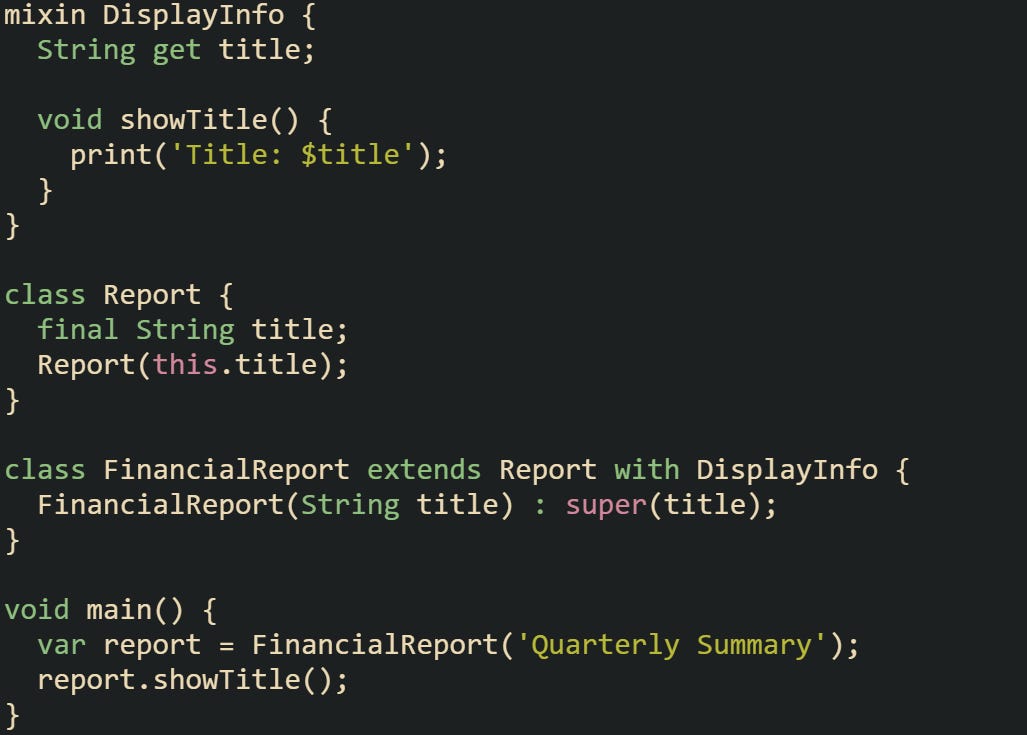
DisplayInfo doesn’t store data, but it assumes the host class provides a title property. That design fits perfectly with Dart’s philosophy that mixins add behavior, not identity.
Through these differences, it’s easy to see why mixins exist as their own feature rather than as a replacement for inheritance. They complement class hierarchies by filling in reusable functionality without altering how objects relate to each other at the type level.
Mixin Constraints and Composition Rules
Mixins can become even more useful when combined with constraints and ordered composition. Dart gives developers fine-grained control over how mixins interact through the on clause, the order of stacking, and the type system rules that define how the compiler handles combined types. These mechanics keep behavior consistent and predictable while letting developers reuse logic across class families in flexible ways. A mixin can depend on existing class features, override earlier mixins, or influence inheritance through compile-time rules. Each part of this system defines how Dart blends reusable behaviors into the class hierarchy while preventing conflicts.
How the on Clause Works
The on clause restricts where a mixin can be applied. It declares that a mixin only works on classes whose superclass chain includes a specific type. This feature helps Dart know that a mixin’s calls to inherited methods are valid.
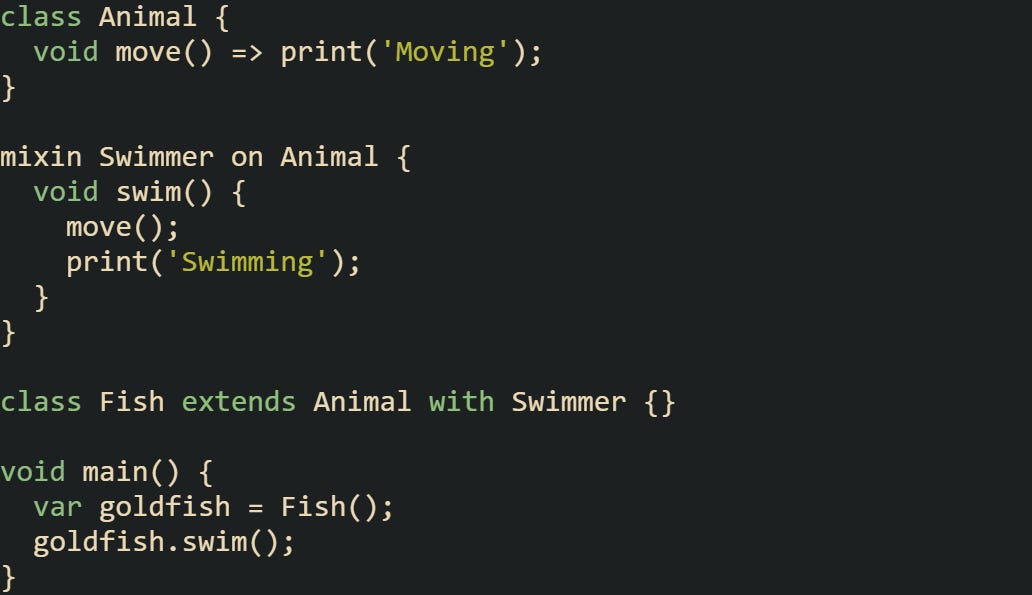
Swimmer can only attach to a class that already extends Animal. Without that relationship, the compiler would reject the mixin because it depends on move(). This keeps code predictable and prevents accidental misuse where a class that lacks a required method tries to include the mixin.
A mixin can also restrict itself to multiple compatible types through interfaces. This gives even more precision when building frameworks or domain-specific layers.
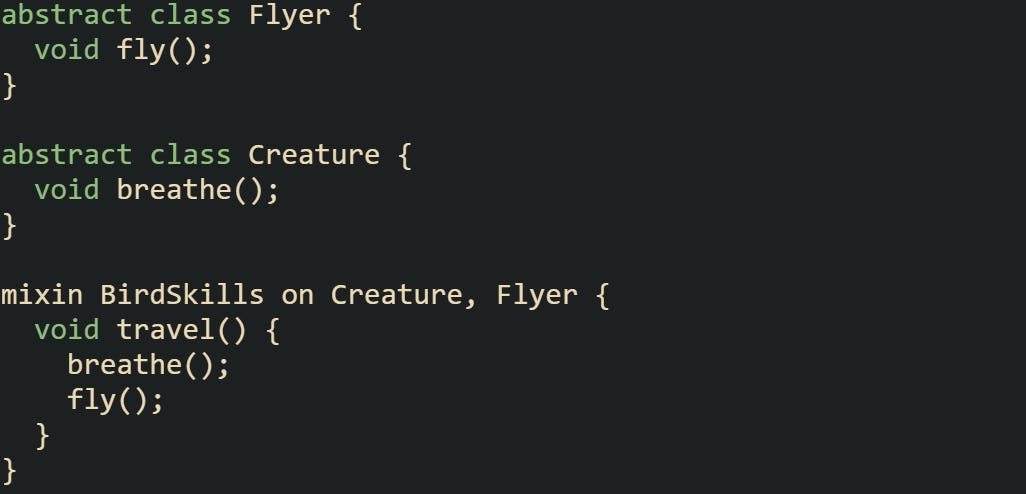
Here, BirdSkills requires both Creature and Flyer. A class must satisfy both conditions or the compiler will raise an error. This form of constraint turns the on clause into a type gate that makes sure mixins integrate correctly into class hierarchies that share expected methods and structures.
This mechanism makes Dart’s type system aware of dependency order during mixin composition. It guarantees that mixins relying on certain inherited properties can be safely merged into compatible targets without runtime surprises.
Stacking Multiple Mixins
Mixins can be applied in sequence, and the order in which they’re listed determines which one takes precedence. Dart applies mixins from left to right, meaning the rightmost mixin overrides methods from those before it. The composition of multiple mixins is a defining feature of Dart’s object system and allows developers to create behavior stacks that function like controlled inheritance layers.
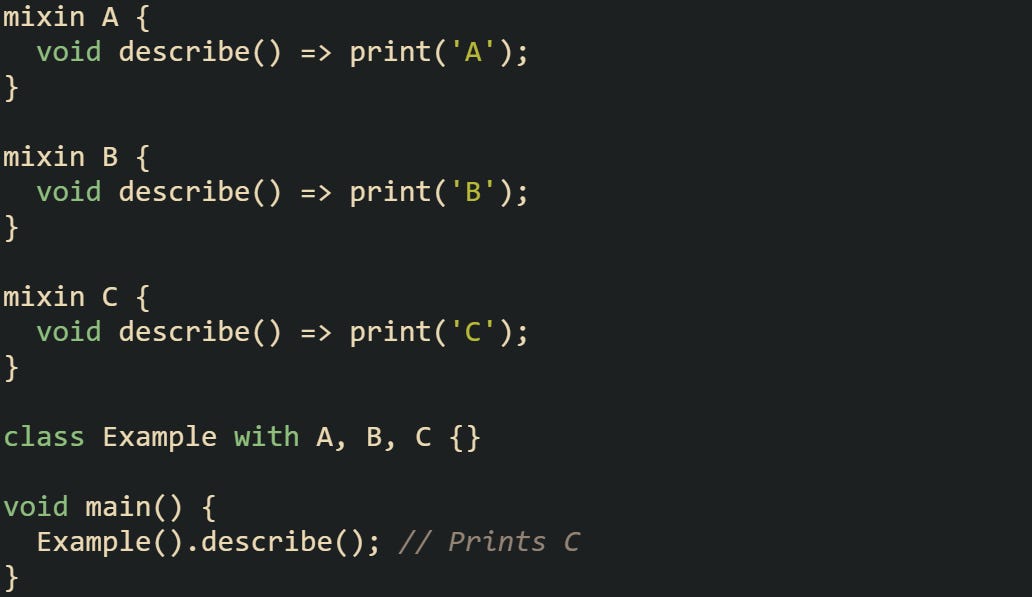
The C here replaces both A and B because it’s applied last. Each mixin becomes part of a synthetic class chain created by the compiler. It builds temporary intermediate classes such as _A&B&C that represent the combined result. This process happens at compile time, making sure there’s no runtime overhead for the mixin stacking logic.
Mixins applied later can call methods from earlier ones through super calls when they are constrained with on clauses.
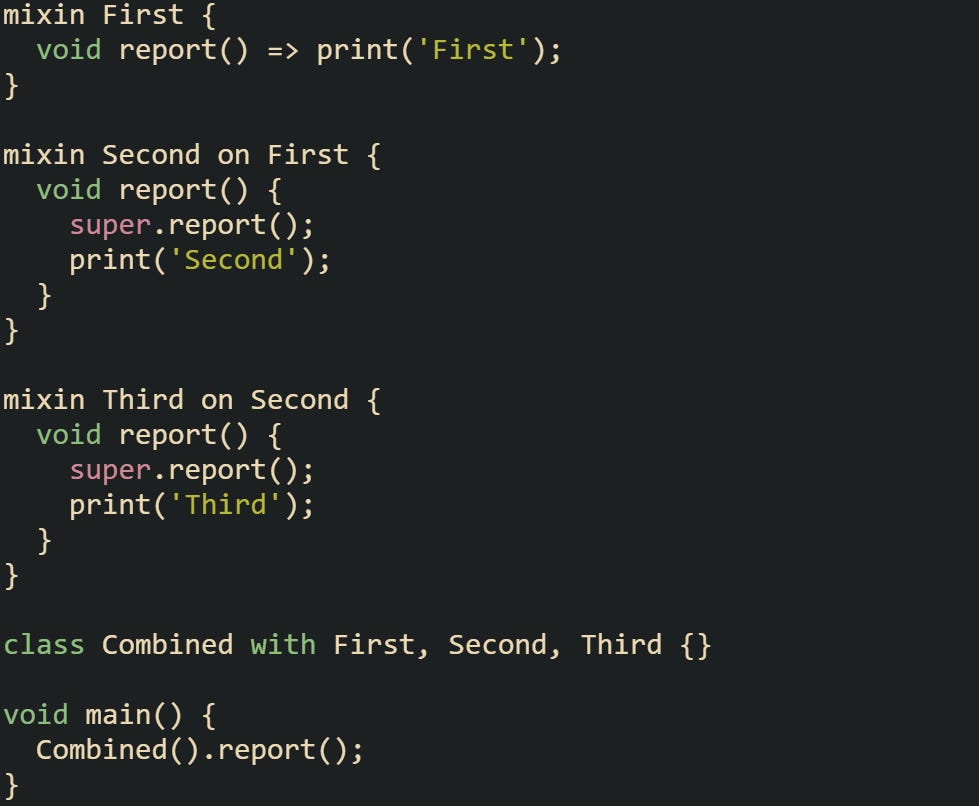
This prints three lines in sequence. Each mixin extends the behavior of the previous one by calling super.report(). Dart’s compiler resolves these calls by generating nested application classes that follow the exact mixin order, which maintains a logical flow from base to top. The stacking rules also make it easier to reason about conflicts. If two mixins define the same field or method, the rightmost one wins. Because this happens at compile time, developers can quickly detect unintended overlaps and refactor before running the code.
How Conditional Mixins Affect Inheritance
While Dart doesn’t directly support runtime conditional mixins, developers can create similar behavior through build-time configuration, generics, or factory constructors. These patterns let different combinations of mixins apply depending on compile-time decisions. This technique keeps code flexible for different environments or versions of an application.
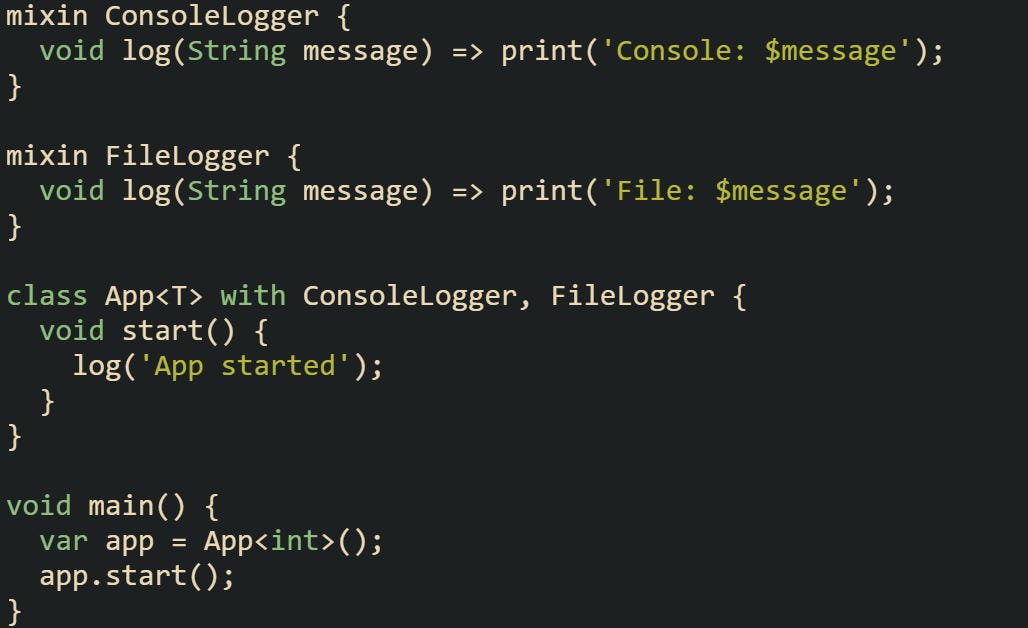
The FileLogger mixin appears last, so its log method overrides the one from ConsoleLogger. Developers can adjust compile-time logic to decide which mixins are included in different environments, such as a development build or a production release.
Generics can still participate in configuration, but the set of mixins on a class is fixed at its declaration. Instead of changing mixins per type argument, you define separate types with the mixin combinations you want and select between them based on build configuration or other compile-time choices.
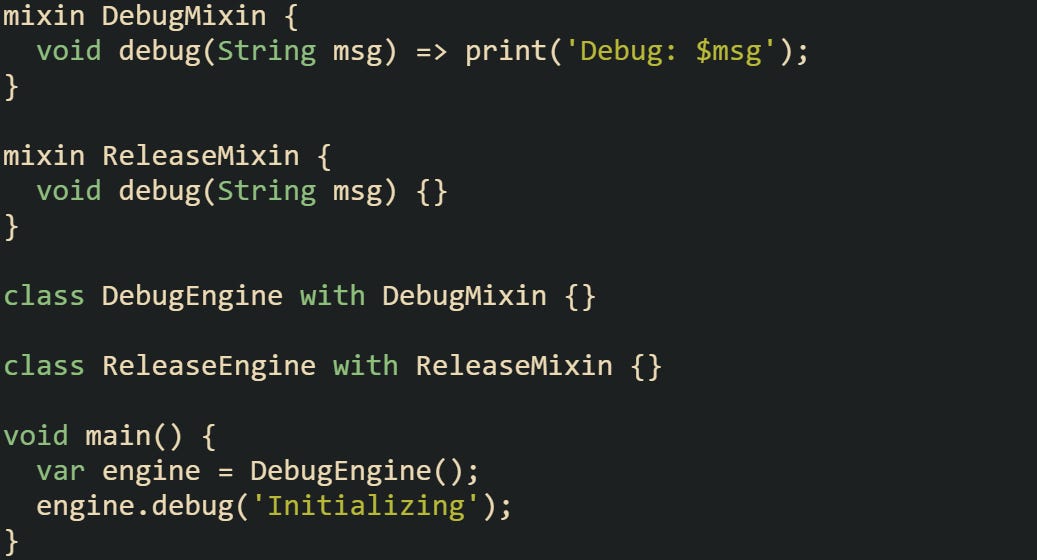
This strategy keeps mixin application static while still letting different builds choose concrete types that match their debugging or performance needs.
How Mixin Composition Impacts Type Identity
Every time Dart applies a mixin, it creates a new composite type that represents the result of combining the base class with one or more mixins. These mixin application types exist at both compile time and runtime. This means that class Car with Engine, Wheels produces a type distinct from Car or either mixin individually.
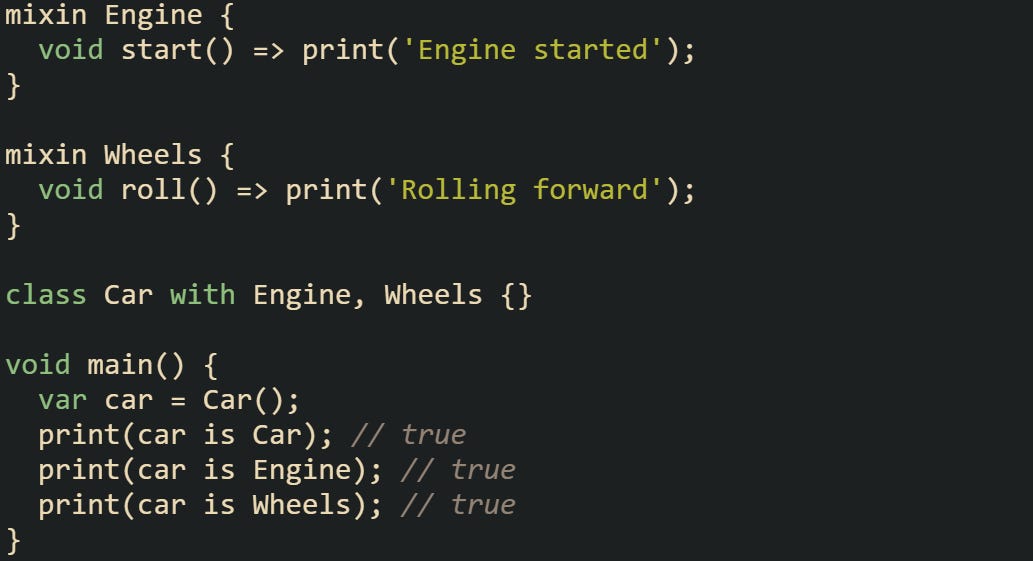
The compiler treats this as if it created a hidden type named _Car&Engine&Wheels. This type carries all the features of Car, Engine, and Wheels while keeping them consistent through Dart’s static type system. That’s why the is operator confirms that the resulting object matches all the participating types. Each mixin application step creates a new intermediate class, which helps Dart maintain clear method resolution order and type relationships. These intermediate types exist only within the compiled program and aren’t directly visible in source code.
Type identity also matters for equality and inheritance checks. Classes that apply mixins are distinct runtime types, even when they list the same mixins in the same order, and changing that order produces a different composite type.
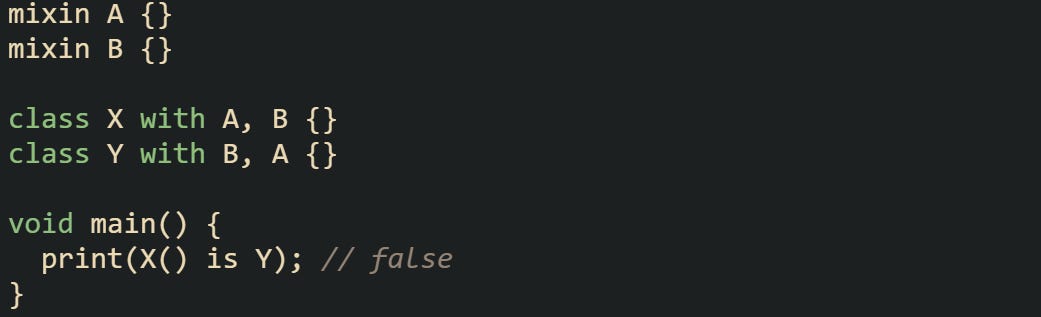
X and Y may contain similar members, but they belong to different composite types. Dart treats them as separate entities because the order of mixin application defines the structure of the resulting class chain. This behavior makes type relationships predictable and traceable, which is important when building frameworks or tools that depend on strong type guarantees.
Conclusion
Mixin application syntax in Dart defines how shared behavior is built, merged, and maintained during compilation. The compiler interprets on clauses, stacking order, and type rules to create a combined structure that works like a single unit at runtime. These mechanics decide how inherited features align, how overlapping methods are resolved, and how each unique mixin combination forms its own type. The process makes composition predictable, preserves performance, and gives developers a consistent way to structure reusable code without overcomplicating inheritance.