


Those learning C run into the * operator next to a variable name and the & operator in front of it very early, and both symbols refer to memory addresses rather than ordinary numeric values, so pointer expressions follow rules that differ from earlier integer or float examples. C stores addresses in pointer types that carry information about the kind of object at that location, and the way those pointer values interact with the address-of and dereference operators, along with pointer arithmetic tied to element size, explains how the language connects pointers to array access on real systems.
Memory Addresses for C Pointers
In C, memory is treated as a long sequence of bytes, and each byte sits at a numbered position called an address. Pointers hold those addresses in a typed way so that the compiler can tell what sort of object lives at that location. With that in mind, it becomes easier to read what a pointer value represents, how large it is on different machines, and why some pointer values are valid while others are not.
What an Address Represents in C
C works with objects such as int, double, or char, and each object occupies one or more bytes in memory. The address of an object is the numeric index of its first byte. On a 64 bit platform, that index is stored in a 64 bit machine word inside the pointer value. On a 32 bit platform, the pointer usually uses 32 bits. The language does not expose a built in integer type that is guaranteed to match the pointer width, but the standard library type uintptr_t from <stdint.h> is intended to hold converted pointer values when code needs to move between integers and pointers.
The pointer type combines that machine address with information about the pointed to type. An int * holds the address of an int, a double * holds the address of a double, and so on. The compiler uses the type to decide how many bytes to read or write when a pointer is dereferenced. For an int *, *p reads sizeof(int) bytes beginning at the stored address. For a char *, *p reads one byte.
Take this example that helps tie those ideas together visually:
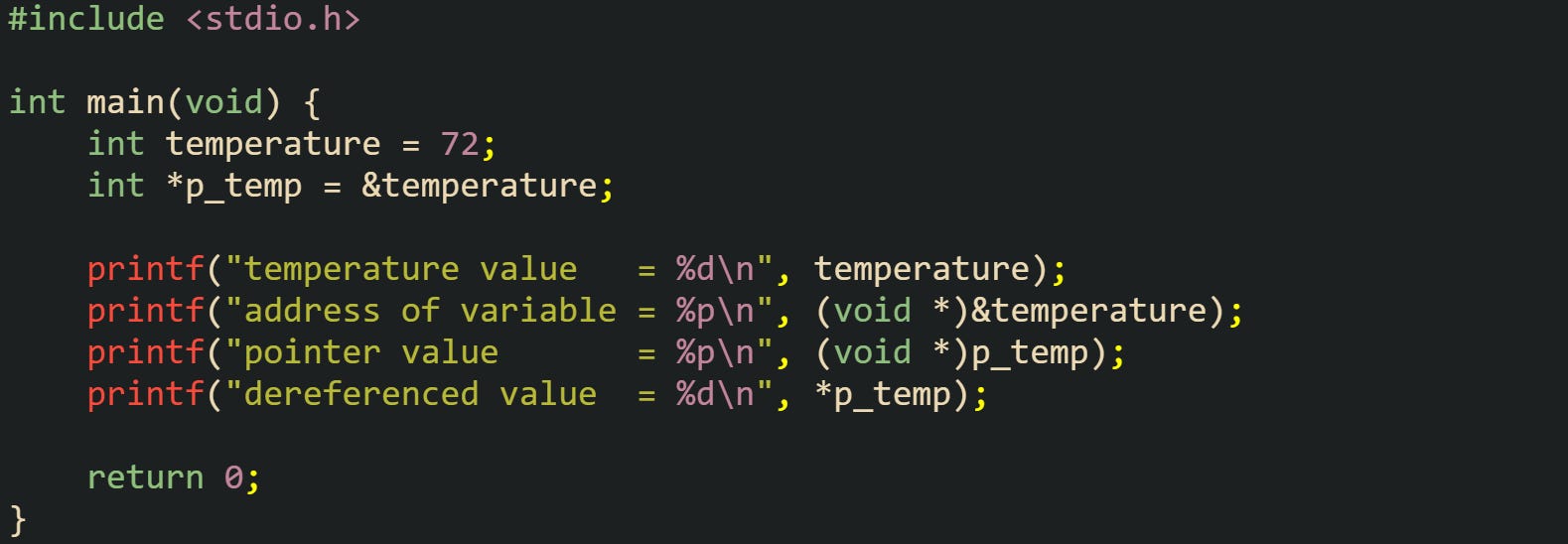
The pointer p_temp does not contain the number 72, it contains whatever address the system assigned to temperature. The %p format prints that address in an implementation defined representation, commonly hexadecimal, and the two %p outputs match because they refer to the same location.
Pointer size is independent of the size of the target type. On many 64 bit platforms, sizeof(int *), sizeof(char *), and sizeof(void *) all evaluate to 8, even though sizeof(int) and sizeof(char) differ. That behavior exists because the machine word that holds the address is the same size no matter what sort of object is stored there. On common 32 bit platforms, those pointer sizes usually evaluate to 4.
The language allows null pointer values that compare unequal to any valid object address. A null pointer is a special bit pattern that does not point to live storage. The macro NULL from headers such as <stddef.h> or <stdio.h> expands to a null pointer constant. In C23, the identifier nullptr is also defined as a null pointer constant of type nullptr_t. Code can test pointers against these values to see whether they hold a useful address.
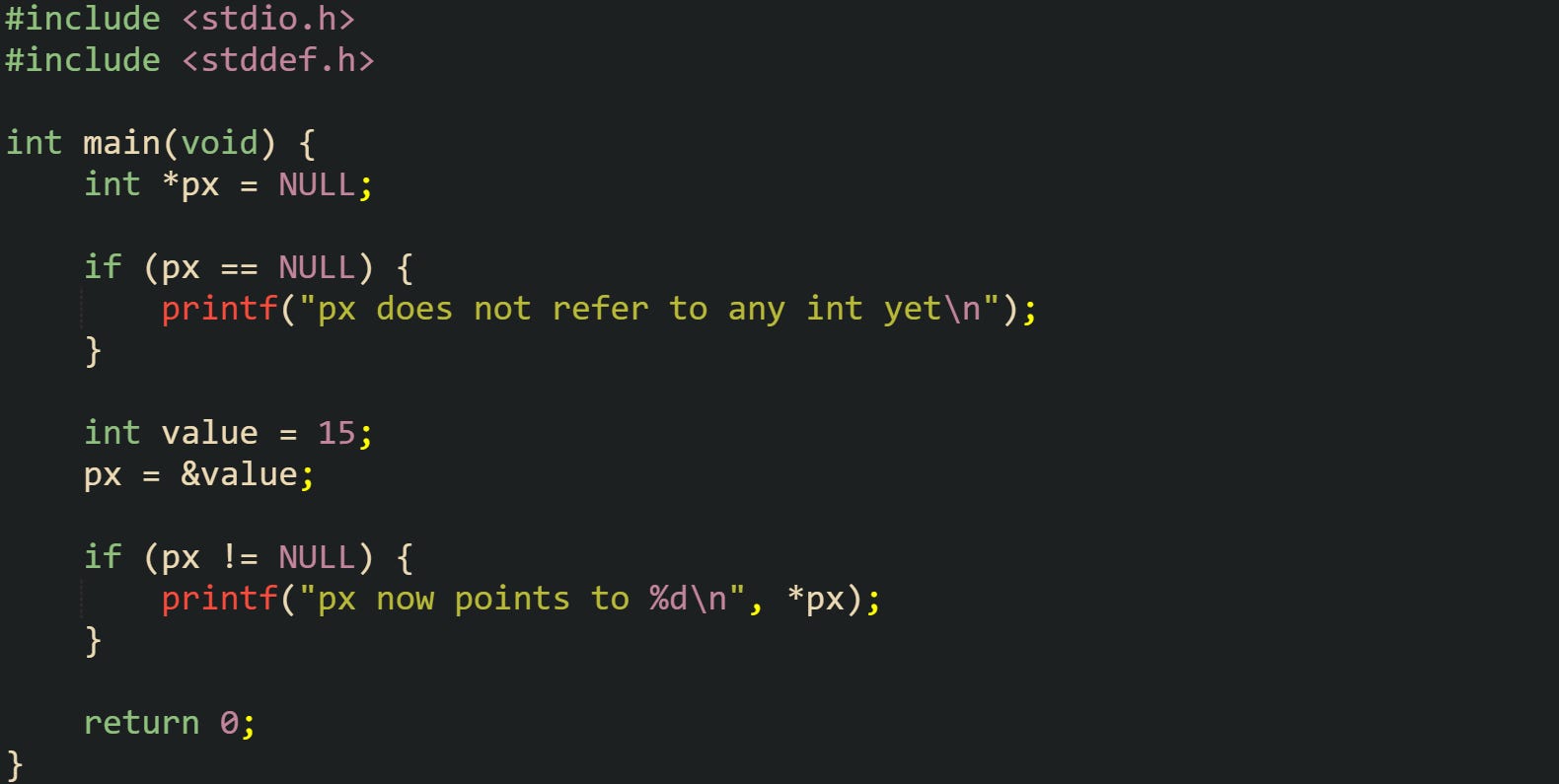
The pointer px in that example starts as a null pointer, then later receives the address of value. That change shows that pointer variables can move between “no object” and “some object” states during a run.
Not every address that fits in the pointer type is valid for the running process. Operating systems restrict which portions of the virtual address space belong to each process, and the C abstract machine speaks in terms of objects that have storage duration and lifetime. If a pointer value refers to storage that has been released, or to storage that never belonged to the process, the pointer still holds a bit pattern but has no valid target in terms of the C memory model.
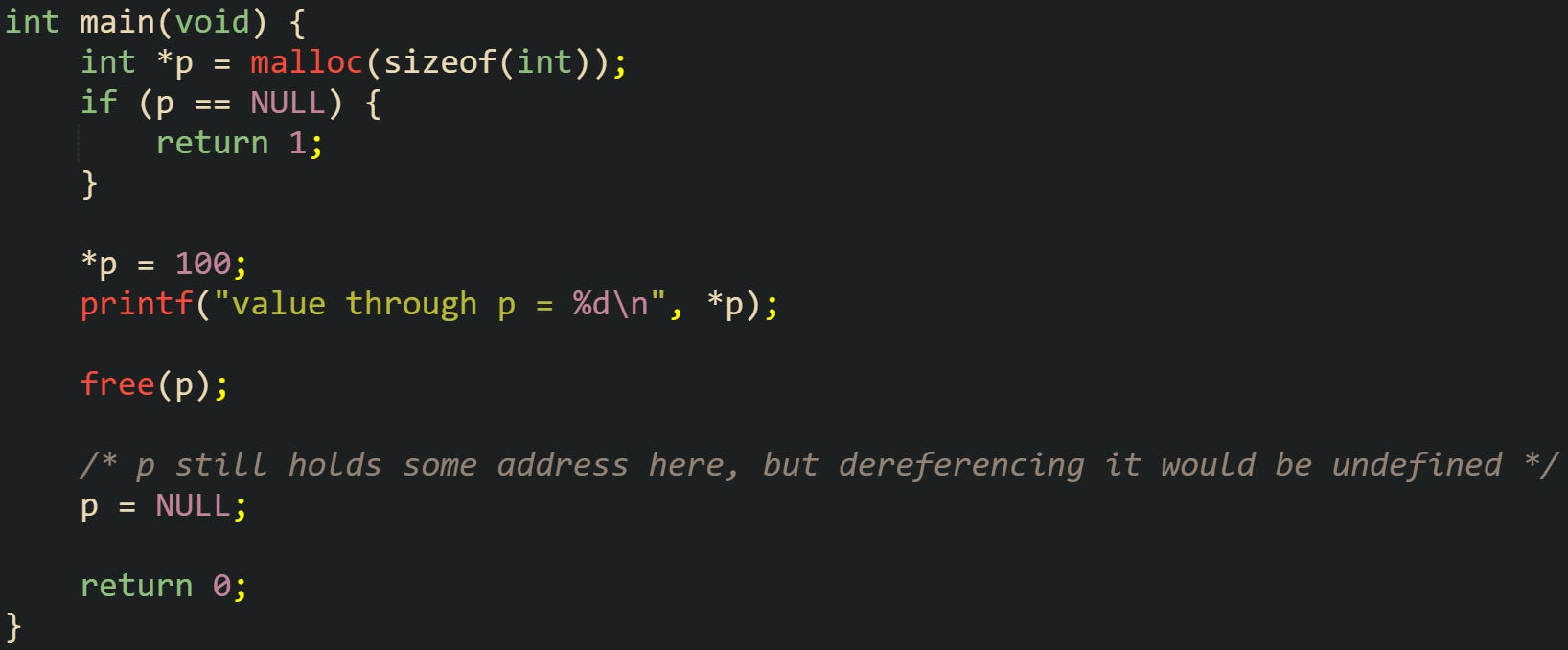
The call to free releases the storage, yet p still contains the old address until it is set to NULL. After free, that address no longer refers to live storage in a defined way.
Pointer Object Layout With Values
Pointer variables in C are objects that occupy storage and hold address values, just as int variables hold plain integers. Code can read and write the pointer variable without touching the target object, and can also read and write the target object through the pointer without altering the pointer bits.
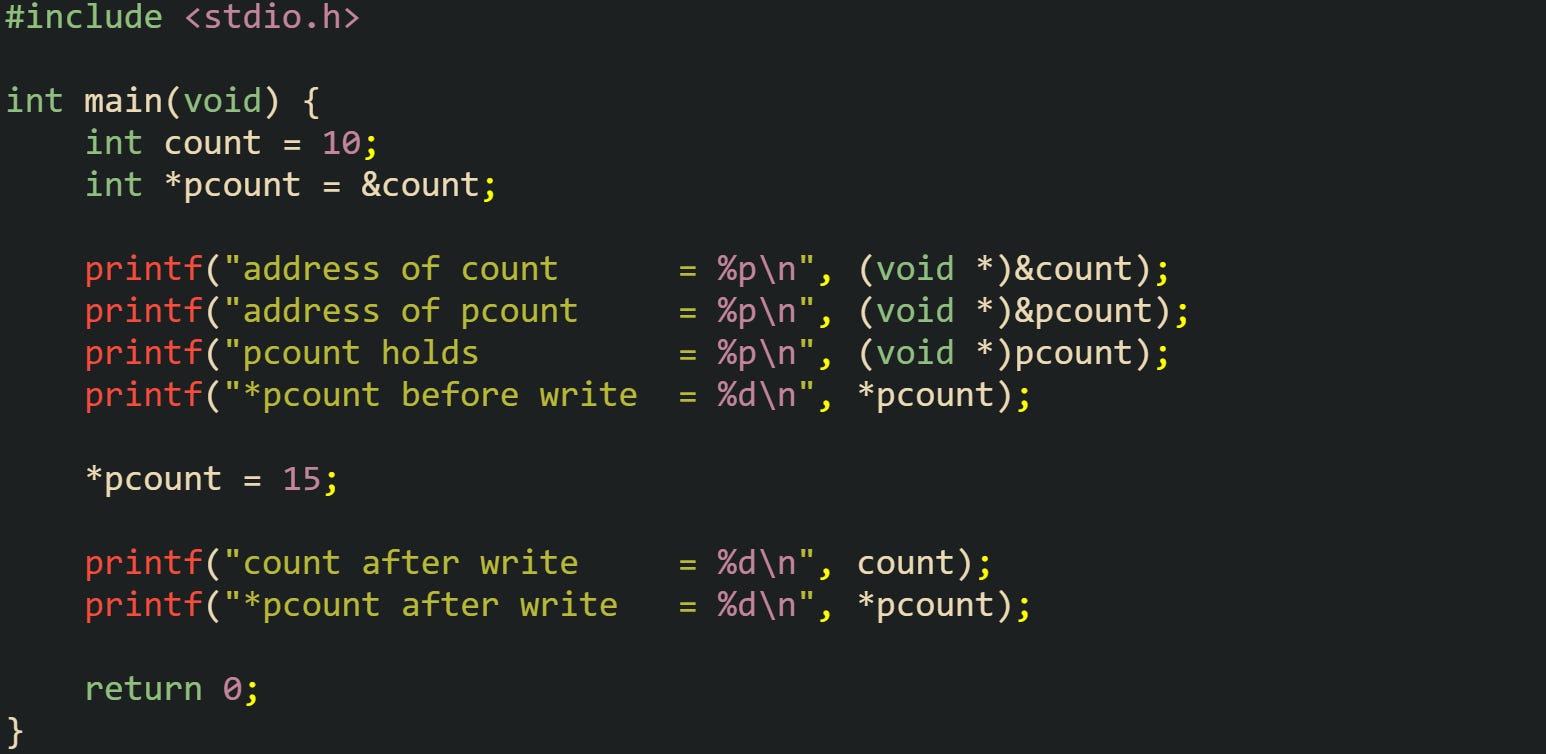
Two different regions of memory appear in that run. One region stores count, which begins at the address printed for &count. Another region stores pcount, which begins at the address printed for &pcount. The pointer variable pcount holds a number that matches &count, so dereferencing it reads and writes the same storage that belongs to count.
Pointer variables obey the same scope and storage duration rules as other variables. When declared inside a function without static, a pointer has automatic storage duration and usually resides in the stack frame for that call. When declared with static at file scope, it resides in static storage. Lifetime of the pointer variable and lifetime of the target object can differ. One typical pattern is a pointer that exists for the entire run of the process but points to different objects at different times.
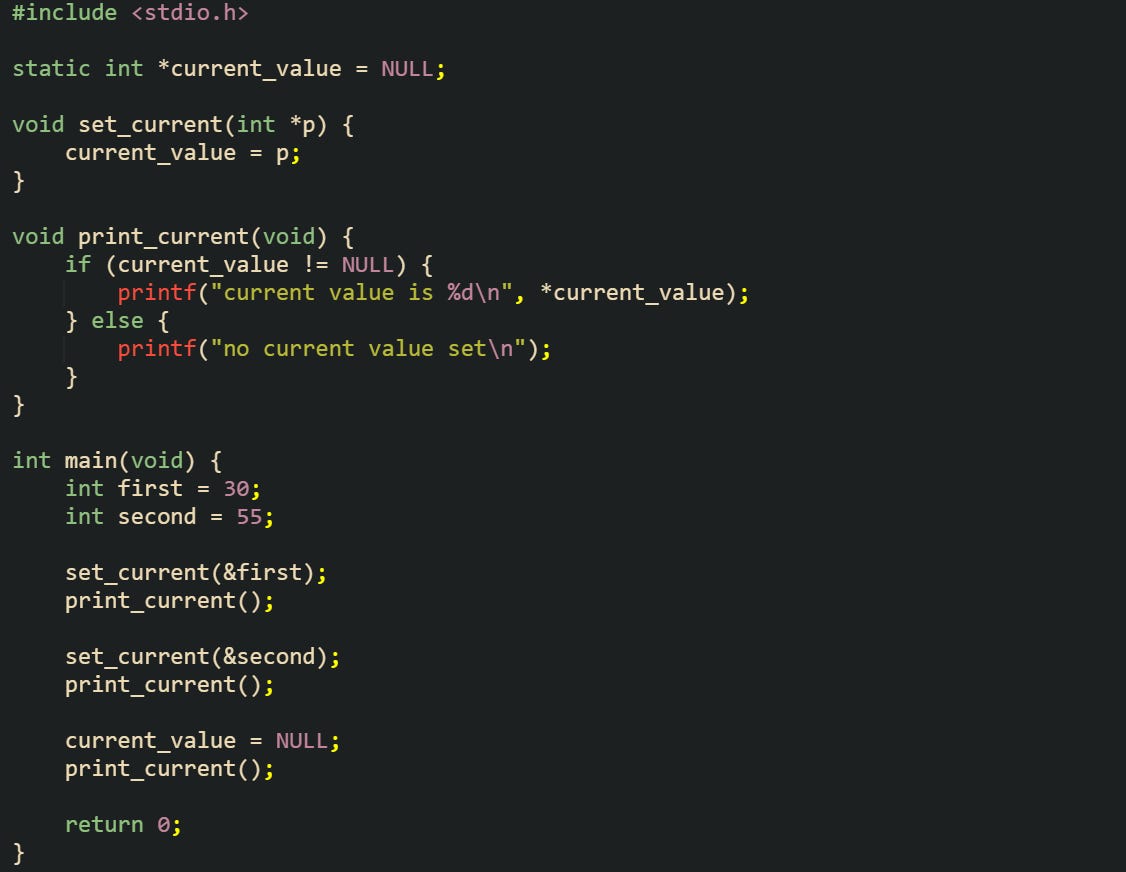
The storage for current_value lives for the entire process, but the value inside that storage flips between &first, &second, and NULL during main. The pointer object stores whichever address is currently active, and the dereference in print_current acts on the target that the pointer carries at that moment.
Assignments between pointers copy address values, not the data they point to. If two pointers refer to the same object, a write through one pointer is visible through the other pointer because they both lead to the same storage.
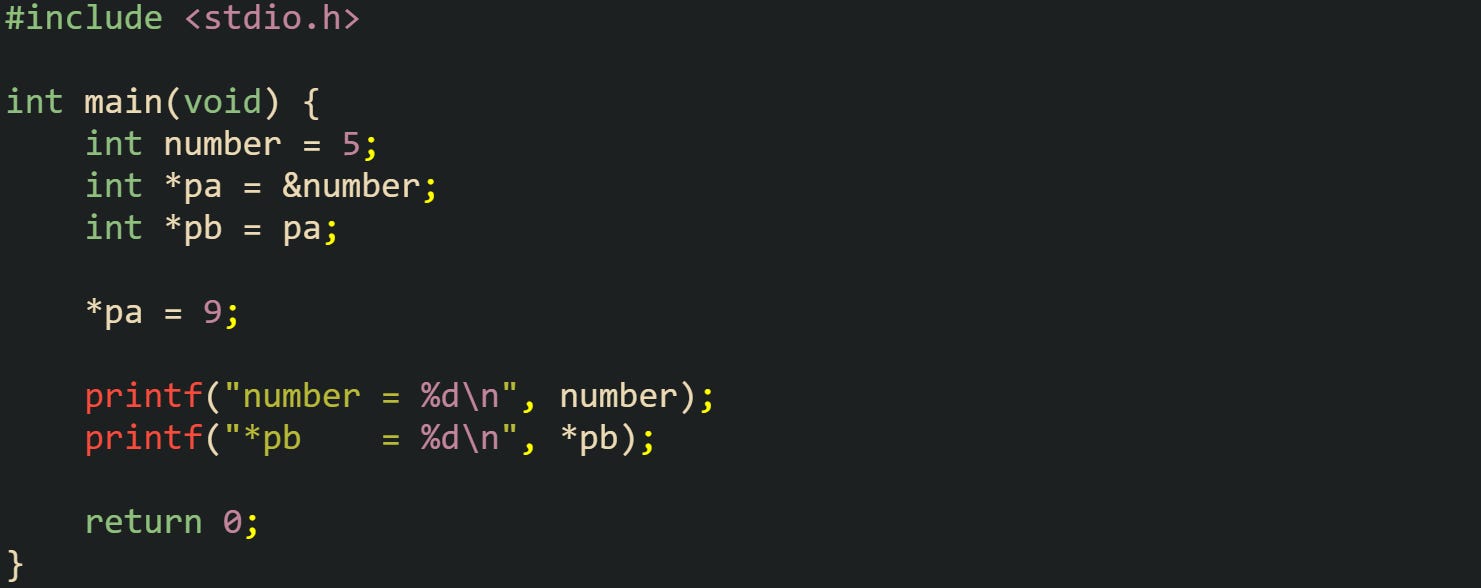
The assignment pb = pa copies the address held by pa. After that line both pointers carry the same value, so dereferencing either one reaches the same number object.
The C memory model also speaks about effective types and aliasing, which affects how multiple pointers can safely refer to the same storage with different types. For basic beginner level use of pointers to scalar types such as int and double, the common pattern is to work with pointers whose target type matches the original object type. More advanced cases, such as treating a block of bytes as different structures through unsigned char *, involve stricter rules and belong to later topics.
Null pointer constants and pointer comparisons round out the picture. Any pointer to object type can be compared to NULL or nullptr, and any pair of pointers that both point within the same array object or to one past its last element can be compared relationally. Those rules are part of how pointer values relate to the abstract memory model, which is built around objects, their storage duration, and the valid region of addresses that describe those objects.
Pointer Syntax With Array Access
Pointer syntax in C ties together types, stars, brackets, and parentheses, and the same rules control how arrays behave when they appear in expressions. When that clicks, declarations, address-of expressions, dereferences, and pointer arithmetic all line up in a consistent way and explain why array indexing and pointer stepping give the same results.
Reading C Pointer Declarations
C declarations follow a rule where the base type appears on the left and the more detailed information gathers around the variable name. That means the same syntax can describe a single pointer, a pointer to a pointer, an array of pointers, a pointer to an array, or a pointer to a function, all by rearranging stars, brackets, and parentheses.
The most basic case introduces a single level of indirection. Such as this declaration:

Here, the base type is int, and the * attached to the declarator name says that ptr holds the address of an int. The star belongs to the declarator, not to the base type, which matters when more than one variable appears in the same declaration.

This declares pa as a pointer to int, while pb is a plain int. Both share the same base type, and only the star attached to pa changes its meaning. Many code bases avoid combining pointer and nonpointer variables in one declaration to keep the meaning obvious at a quick look.
C encourages reading complex declarations by starting at the variable name, then moving right when possible, then left, while paying attention to parentheses. Take this group of declarations:
![int *pvalue; int **ppvalue; int *row[10]; int (*parray)[10];](https://substackcdn.com/image/fetch/$s_!KUip!,f_auto,q_auto:good,fl_progressive:steep/https%3A%2F%2Fsubstack-post-media.s3.amazonaws.com%2Fpublic%2Fimages%2F614cb165-c851-4faa-b4fa-de32f4a51de1_1485x168.png "int *pvalue; int **ppvalue; int *row[10]; int (*parray)[10];")
The identifier pvalue sits next to a single *, so pvalue is a pointer to int. The identifier ppvalue sits next to two stars, so it is a pointer to a pointer to int. The identifier row sits next to [10], which binds more tightly than *, so row is an array of ten elements where each element has type int *. The identifier parray sits inside parentheses with *, and that group sits next to [10], so parray is a pointer to an array of ten int values.
Function pointers follow the same reading rule. Parentheses make the boundary between the pointer itself and the function type easier to see. Take a declaration like:

This starts with the identifier pfunc surrounded by (* ), so *pfunc has function type that takes an int and a double and returns double. That means pfunc is a pointer to such a function. Without the parentheses, a declaration double *pfunc(int, double); would describe a function returning double * instead, which is very different.
These reading habits scale up. Arrays of function pointers, pointers to arrays of function pointers, and other advanced combinations obey the same rule. For a beginner, working through a few declarations by hand and tracing from the name outward helps reinforce how stars, brackets, and parentheses combine to describe storage and behavior.
Address Of Operator Plus Dereference Operator
Two operators sit at the heart of pointer use in C. The address of operator & takes the location of an object, and the dereference operator * accesses the object that lives at a stored address. They are defined so that they cancel each other out for ordinary objects, which gives a useful mental model for how references move between variables and memory.
Take a small fragment of code that connects a pointer to a plain variable:
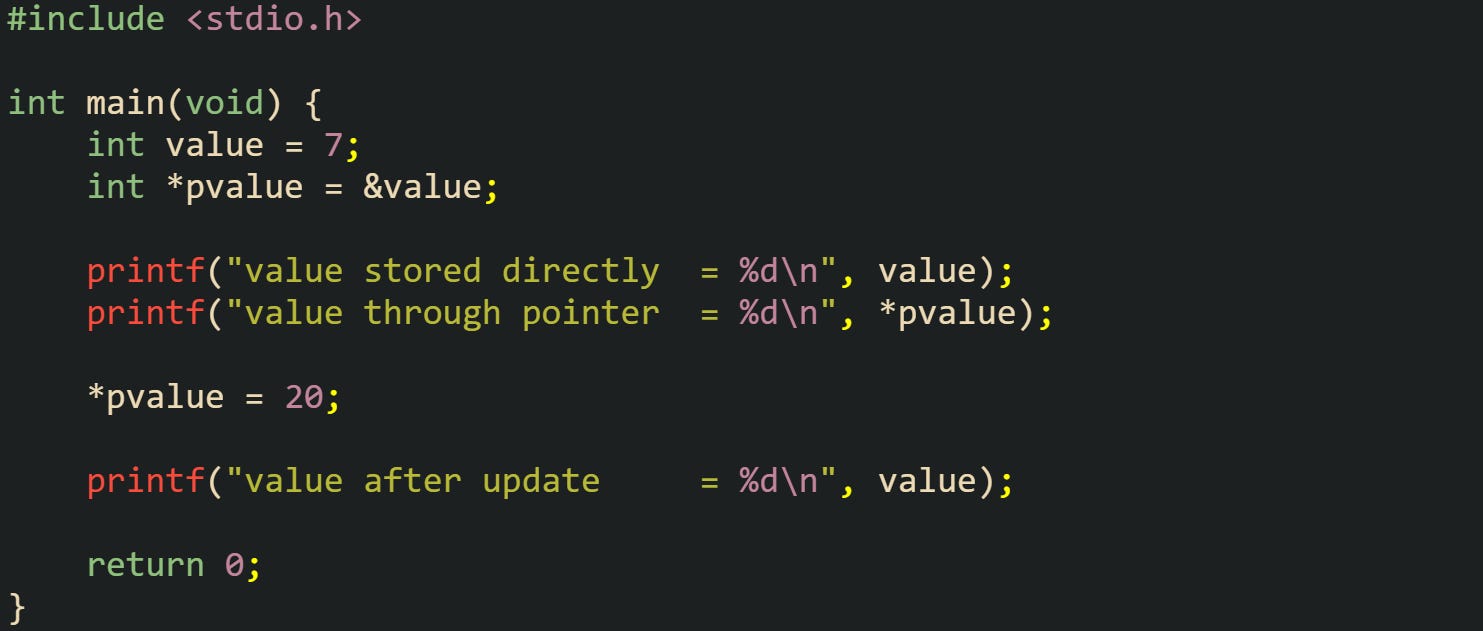
The expression &value forms an int * that holds the address of value. That address is stored in pvalue. The dereference *pvalue accesses the int at that address. When *pvalue appears on the left side of an assignment, the assignment writes through the pointer to the original value variable.
For an object x of type T, the expression &x has type T *, and the expression *(&x) refers back to x. The two operators behave as inverse steps for that case. In the other direction, if p is a T * that currently holds &x, then *p and x name the same storage. That relationship is what makes passing pointers into functions a way to let those functions update caller variables.
A slight change in syntax can either change the object pointed to or change the pointer value. With a declaration such as:

The expression (*pcount)++ increments the int stored at the address, leaving pcount unchanged. An expression pcount++ increments the pointer value so it refers to the next int in memory, leaving the stored int unchanged. Parentheses in (*pcount)++ force the dereference to happen before the increment.
Passing pointers to functions brings the address of a caller variable into a callee without copying the variable itself. That pattern appears frequently in simple numeric examples.
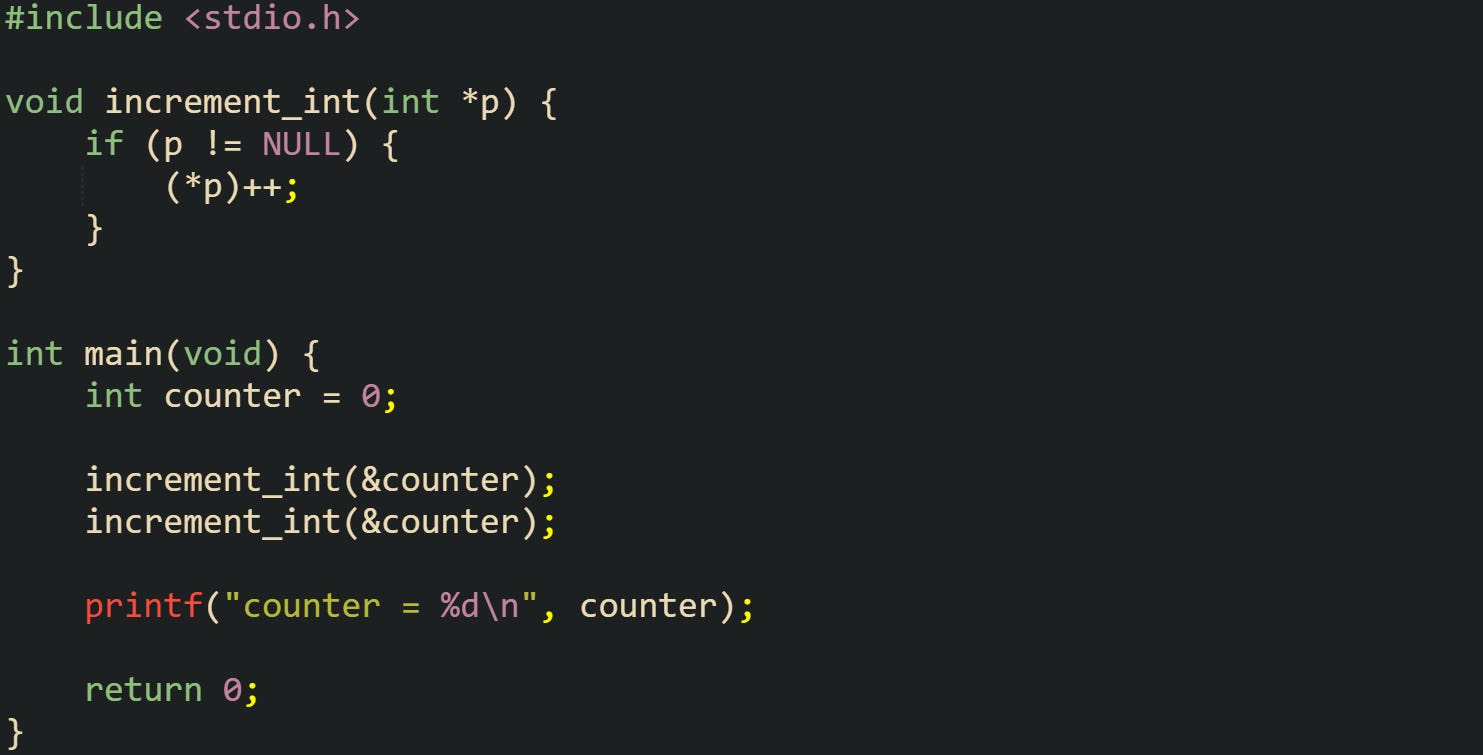
The function increment_int receives an int * and, after a null check, dereferences it and increments the referred value. The caller passes &counter, so the updates apply directly to counter. No copy of counter needs to travel into the function; only its address moves across the call boundary.
Dereferencing requires that the pointer value refers to live storage of the correct type. Applying * to a null pointer or to a pointer that holds an address of freed storage leads to undefined behavior in C, which means the standard does not specify what happens. Keeping careful track of where each pointer came from and whether its target still exists is part of correct use of & and *.
Pointer Arithmetic With Arrays
Pointer arithmetic gives a way to move through sequences of objects in memory. For a pointer p of type T *, adding an integer offset n produces a new pointer p + n that points n elements past p. The compiler multiplies the offset by sizeof(T) to compute the byte address that matches that new pointer value.
Arrays and pointers meet at this point. In many expressions, an array name converts to a pointer to its first element. Like this declaration:
![#include <stdio.h> int main(void) { int scores[5] = {10, 20, 30, 40, 50}; int *ps = scores; printf("scores[0] with index = %d\n", scores[0]); printf("scores[0] with pointer = %d\n", *ps); ps = ps + 2; printf("scores[2] with pointer = %d\n", *ps); return 0; }](https://substackcdn.com/image/fetch/$s_!n0sj!,f_auto,q_auto:good,fl_progressive:steep/https%3A%2F%2Fsubstack-post-media.s3.amazonaws.com%2Fpublic%2Fimages%2F3e05bb5d-fbc3-4877-adad-ad685917609e_1481x673.png "#include <stdio.h> int main(void) { int scores[5] = {10, 20, 30, 40, 50}; int *ps = scores; printf(\"scores[0] with index = %d\n\", scores[0]); printf(\"scores[0] with pointer = %d\n\", *ps); ps = ps + 2; printf(\"scores[2] with pointer = %d\n\", *ps); return 0; }")
Here, the expression scores in the line int *ps = scores; converts to a pointer of type int * that holds the address of scores[0]. The expression *ps reads the same int as scores[0]. After ps = ps + 2, the pointer refers to scores[2], and dereferencing reads the third element in the array. The subscript expression scores[i] is defined by the language as *(scores + i), which explains why indexing and pointer stepping end up at the same locations.
Element size controls how far pointer arithmetic steps in bytes. On a system where sizeof(int) is 4, adding 1 to an int * advances the address by 4 bytes. On that same system, adding 1 to a double * advances by sizeof(double) bytes, and so on. The compiler handles that scaling internally, so source code can work in units of elements rather than raw bytes.
Single byte access uses char * or unsigned char *. C defines sizeof(char) as 1, so incrementing a char * moves the address by one byte each time. A short fragment shows the contrast between element stepping and byte stepping:
![#include <stdio.h> int main(void) { int values[3] = {1, 2, 3}; int *pi = values; unsigned char *pb = (unsigned char *)values; printf("pi = %p\n", (void *)pi); printf("pi + 1 = %p\n", (void *)(pi + 1)); printf("pb = %p\n", (void *)pb); printf("pb + 1 = %p\n", (void *)(pb + 1)); printf("pb + 4 = %p\n", (void *)(pb + 4)); return 0; }](https://substackcdn.com/image/fetch/$s_!ktuy!,f_auto,q_auto:good,fl_progressive:steep/https%3A%2F%2Fsubstack-post-media.s3.amazonaws.com%2Fpublic%2Fimages%2Fefee981e-384d-4b88-a3df-8fd0531f8324_1484x716.png "#include <stdio.h> int main(void) { int values[3] = {1, 2, 3}; int *pi = values; unsigned char *pb = (unsigned char *)values; printf(\"pi = %p\n\", (void *)pi); printf(\"pi + 1 = %p\n\", (void *)(pi + 1)); printf(\"pb = %p\n\", (void *)pb); printf(\"pb + 1 = %p\n\", (void *)(pb + 1)); printf(\"pb + 4 = %p\n\", (void *)(pb + 4)); return 0; }")
The pointer pi + 1 advances by one int, while pb + 1 advances by a single byte, and pb + 4 lands at the same address as pi + 1 on systems where sizeof(int) equals 4. This kind of comparison makes the scaling rule very solid to see.
Pointer arithmetic is defined only for pointers that refer into an array object or to one element past its last entry. Adding offsets that move a pointer outside that region gives undefined behavior, even if the code never dereferences the out of range pointer. That rule lets compilers apply reasoning about loops that walk arrays and lets them map those loops onto efficient machine instructions that operate on contiguous memory.
Conclusion
Pointers link C code to concrete memory locations, with each pointer object storing an address in a machine word along with a static type that tells the compiler how many bytes belong to the target. The & operator moves from an object to its address, the * operator moves from a stored address back to the object, and pointer arithmetic steps in units of whole elements so that expressions like a[i] and *(a + i) describe the same access pattern through contiguous storage. With those mechanics in place, dynamic allocation, pointer parameters, and linked data structures all follow from the same rules about addresses, types, and element-sized movement through memory.