

How the Sysmon Thread Works in Go
The sysmon thread exists to handle work that can’t be left to the regular scheduler loop. While goroutines drive application logic, the sysmon thread keeps track of system events, timers, and scheduling fairness. It quietly runs alongside everything else, waking at intervals to do checks that keep execution smooth. This background presence is what makes deadlines fire at the right time, prevents CPU starvation, and keeps long-running servers from drifting out of balance.
Monitoring System Calls
When a goroutine makes a blocking system call, the runtime cannot predict how long it will be stuck waiting. A file read from a slow disk or a network request over a congested connection could take milliseconds or seconds. If the scheduler assumed that goroutine was still making progress, other goroutines could be delayed. The sysmon thread helps by scanning for operating system threads that remain blocked too long and then reassigns ready goroutines to threads that are free.
This ability is particularly important for workloads that rely heavily on network or file operations. It means a single blocked call won’t freeze all goroutines tied to that thread. To get a sense of this, imagine a function that makes a long read:
![package main import ( "fmt" "os" ) func main() { f, err := os.Open("largefile.log") if err != nil { panic(err) } buf := make([]byte, 1024*1024) n, err := f.Read(buf) // may block at the system call level if err != nil { panic(err) } fmt.Println("Read bytes:", n) }](https://substackcdn.com/image/fetch/$s_!jEEP!,f_auto,q_auto:good,fl_progressive:steep/https%3A%2F%2Fsubstack-post-media.s3.amazonaws.com%2Fpublic%2Fimages%2F4d58208a-8d63-4f5b-a2b1-a488fcf7b0d2_1050x663.png "package main import ( \"fmt\" \"os\" ) func main() { f, err := os.Open(\"largefile.log\") if err != nil { panic(err) } buf := make([]byte, 1024*1024) n, err := f.Read(buf) // may block at the system call level if err != nil { panic(err) } fmt.Println(\"Read bytes:\", n) }")
During the call to f.Read, the goroutine can block in the kernel. If that thread holds a P for too long, sysmon retakes the P so other runnable goroutines keep executing. That simple redistribution is why Go scales well across many concurrent operations.
Driving Timers
Timers are a fundamental building block in Go. Functions like time.NewTimer, time.After, and time.Ticker all rely on accurate tracking of deadlines. The runtime keeps per P timer heaps and relies on the netpoll waiter for the next deadline. When a timer expires, the scheduler readies the waiting goroutine. The sysmon thread makes sure there’s an idle M blocked in netpoll when needed and starts work when events or deadlines show up. This isn’t only about delays measured in seconds. Many servers and clients depend on millisecond-level accuracy to enforce request deadlines or connection limits. Without the sysmon thread, expired timers could sit in the heap unnoticed for long stretches, breaking the reliability of those guarantees.
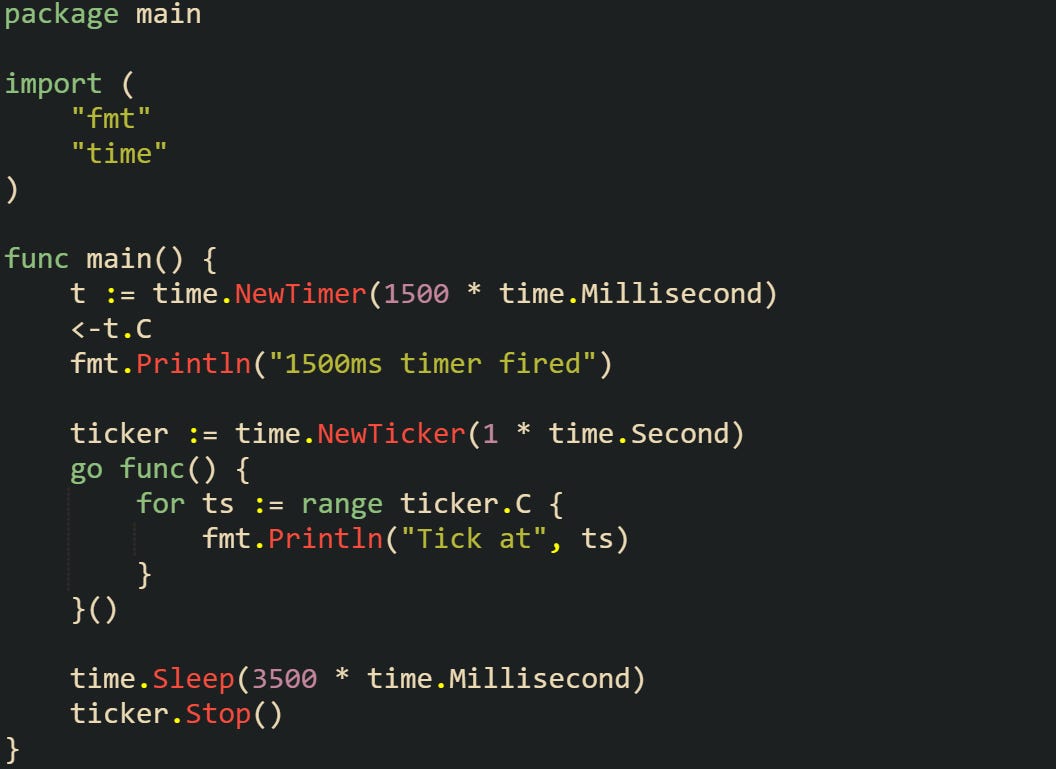
Here, the timer and ticker depend on the per P timer heaps and netpoll deadlines. The runtime parks an idle M in netpoll with the nearest timer deadline, and sysmon kicks scheduling if events or deadlines arrive. This interplay makes Go’s timing constructs dependable even across thousands of concurrent goroutines.
Preempting Long Running Goroutines
Without preemption, a goroutine that performs heavy CPU work could occupy a thread indefinitely. Cooperative scheduling alone depends on goroutines reaching safe points and yielding, but code doesn’t always do that quickly enough. sysmon requests preemption of long-running goroutines so others can run. The runtime performs asynchronous preemption at safe points.
This keeps the system fair, letting others make progress even if one is consuming cycles in a loop. Consider a worker function like this:
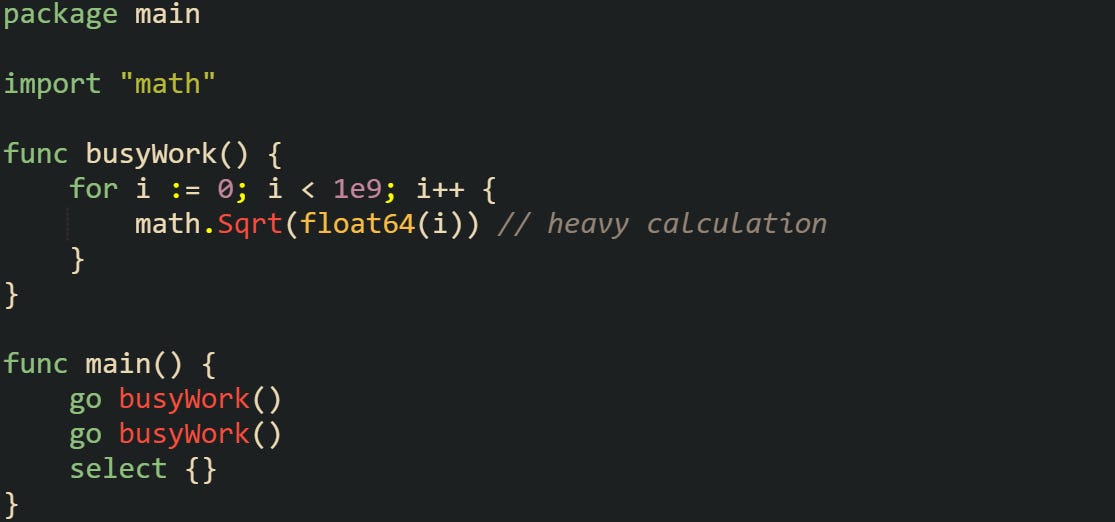
Both goroutines run an expensive loop. Without the sysmon thread enforcing preemption, one could monopolize a thread and delay the other indefinitely. Instead, the sysmon thread steps in and makes sure that the time is shared across them. This is invisible to the programmer, but it’s the reason Go’s scheduler remains fair even with workloads that lean on CPU.
For developers writing compute-heavy code, this means other goroutines won’t starve. Long computations still progress, but they’re broken into time slices that let the rest of the system stay responsive.
Scheduling Delayed Events
The sysmon thread also performs regular checks for runtime events not directly tied to user timers. Memory scavenging is one example. Go’s garbage collector reclaims memory inside the runtime, but returning unused memory back to the operating system requires periodic work. The sysmon thread triggers this process without pausing normal execution. GC timing is driven by the GC pacer and heap growth targets. sysmon does two different things here: it can force a GC if none has run for about two minutes via forcegcperiod, and it can wake the scavenger that returns pages to the OS. Developers don’t usually see this directly, but they benefit from a system that doesn’t grow memory usage endlessly.
Here’s some simple code that allocates memory repeatedly:
![package main func main() { for { _ = make([]byte, 10*1024*1024) // allocate 10MB } }](https://substackcdn.com/image/fetch/$s_!05C6!,f_auto,q_auto:good,fl_progressive:steep/https%3A%2F%2Fsubstack-post-media.s3.amazonaws.com%2Fpublic%2Fimages%2Fda391e25-e4cf-4002-8d60-a2b3bb9b895d_1124x245.png "package main func main() { for { _ = make([]byte, 10*1024*1024) // allocate 10MB } }")
Running this without scavenging would push memory usage upward and never release it. The sysmon thread helps schedule background work that eventually hands memory back to the operating system. That’s why long-running servers built in Go can stay stable without ballooning in memory over time.
The scheduling of these delayed events reflects the runtime’s need to coordinate work at different levels. Application code runs in goroutines, but the sysmon thread takes care of the background tasks that keep the runtime itself healthy. Without it, timers would drift, blocked system calls would trap threads, and memory management would fail to keep up.
Why the Sysmon Thread Matters
The sysmon thread doesn’t run application logic directly, yet without it the Go runtime wouldn’t behave reliably. Its work provides stability to the scheduler, accuracy to timers, fairness across goroutines, and background upkeep that keeps long-running processes in balance. Developers rarely interact with this thread, but every Go program depends on it in one way or another.
Keeping the Scheduler Moving
Goroutines need to be scheduled across operating system threads. If one thread becomes stuck waiting for a system call, the scheduler has to find other places to run the goroutines that are still ready. The sysmon thread performs scans to detect these situations and helps the runtime move work elsewhere. That way the system as a whole keeps moving forward even when parts of it are waiting on I/O.
Consider a server that spawns goroutines for each incoming connection. Some connections are quick, while others stall on slow clients. Without sysmon stepping in, stalled goroutines could tie up threads for long stretches.
![package main import ( "fmt" "net" ) func handleConn(c net.Conn) { buf := make([]byte, 1024) // Read may block if the client stops sending data _, _ = c.Read(buf) fmt.Println("Finished handling client") c.Close() } func main() { ln, _ := net.Listen("tcp", ":8081") for { conn, _ := ln.Accept() go handleConn(conn) } }](https://substackcdn.com/image/fetch/$s_!9iLb!,f_auto,q_auto:good,fl_progressive:steep/https%3A%2F%2Fsubstack-post-media.s3.amazonaws.com%2Fpublic%2Fimages%2F9123d549-3bfb-47d6-8417-9a3f7d7eccc9_1116x768.png "package main import ( \"fmt\" \"net\" ) func handleConn(c net.Conn) { buf := make([]byte, 1024) // Read may block if the client stops sending data _, _ = c.Read(buf) fmt.Println(\"Finished handling client\") c.Close() } func main() { ln, _ := net.Listen(\"tcp\", \":8081\") for { conn, _ := ln.Accept() go handleConn(conn) } }")
A client that connects but never sends data would leave a goroutine blocked inside Read. The sysmon thread prevents that blocked goroutine from holding up the rest of the server by making sure that the other goroutines continue running on available threads.
Accurate Timers and Deadlines
Deadlines in Go are only useful if they’re fired precisely. The sysmon thread checks pending timers across the per-P heaps and makes sure expired timers wake the goroutines waiting on them. Without this, network timeouts and request deadlines wouldn’t behave predictably.
One option is setting a timeout on a network dial. The timeout depends entirely on the timer being serviced promptly.
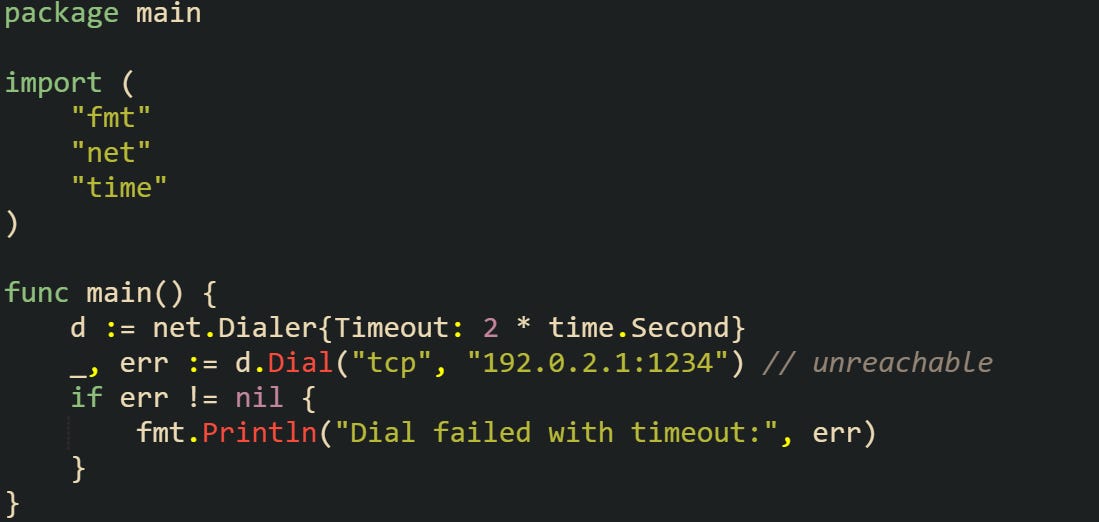
The dialer here relies on the sysmon thread to wake the timer after two seconds. Without it, the operation could hang indefinitely.
Timers are not limited to network timeouts. They’re also behind scheduled jobs, delayed retries, and heartbeat signals. A ticker that drives periodic updates, for example, also depends on the sysmon thread:
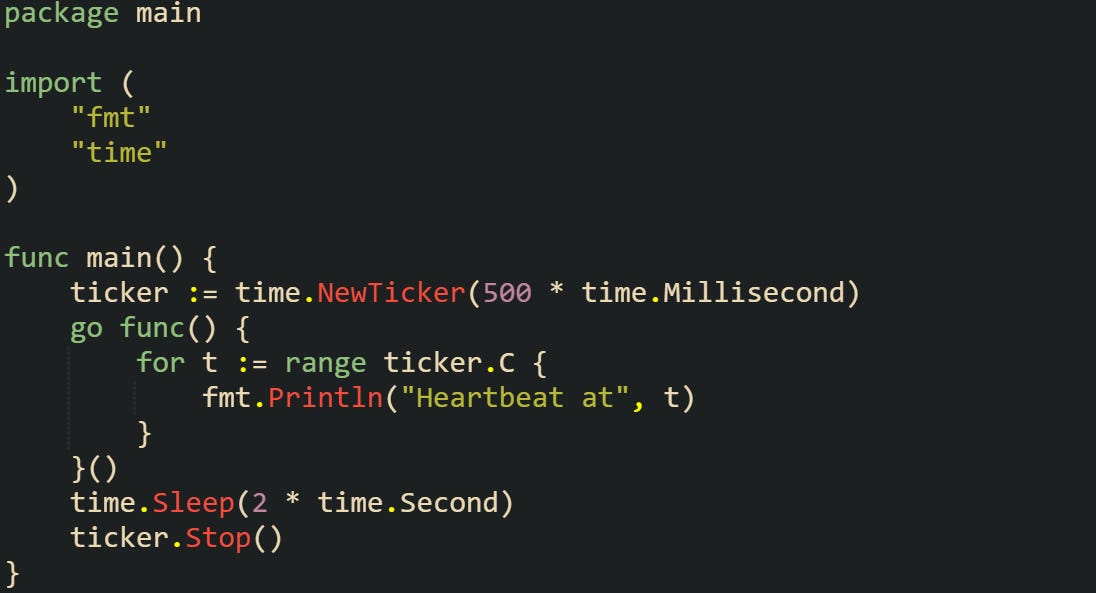
The steady rhythm of the ticker reflects the sysmon thread scanning timers and scheduling their events on time.
Preemptive Fairness
Fairness across goroutines is another area where the sysmon thread has direct impact. CPU-heavy goroutines don’t always yield naturally, which could allow them to run for extended periods while other goroutines starve. The sysmon thread interrupts those long runs by requesting preemption once they exceed their time slice.
This feature makes Go suitable for mixed workloads. A program can juggle network servers alongside compute-intensive goroutines without one category blocking the other.
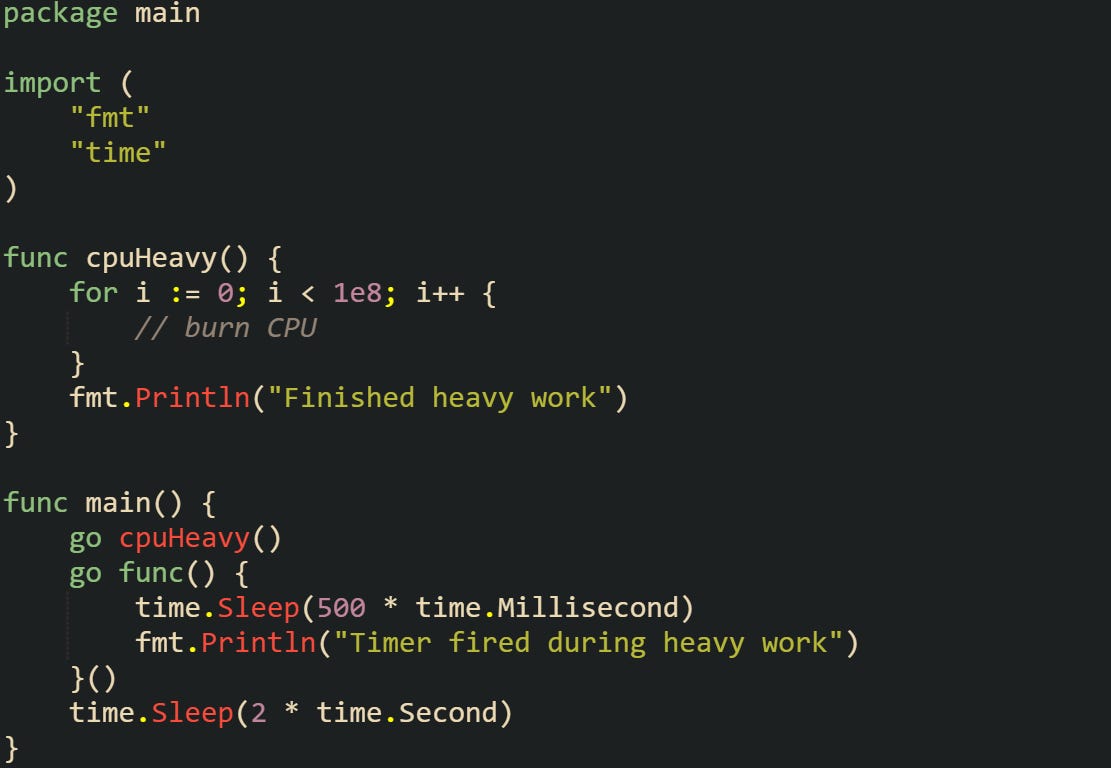
Even though one goroutine spends time in a large loop, the sleeping goroutine’s timer still fires because sysmon forces the heavy loop to pause at safe points. The output reflects that fairness, keeping the system responsive even when workloads vary.
System Stability
The sysmon thread doesn’t just service timers and preemption. It also handles background duties that make Go stable in production. Memory scavenging is one such duty, where unused memory is handed back to the operating system. Without this, long-running processes would consume memory indefinitely even after internal reuse dropped. There’s also the matter of coordinating with garbage collection. The runtime has to decide when to trigger collection cycles, and sysmon provides pacing signals to keep those cycles in balance with allocation pressure. Developers rarely see this interaction directly, but the stability of long-lived services depends on it.
Consider a service that keeps a growing in-memory buffer for work items:
![package main func main() { buf := make([]byte, 0, 100*1024*1024) // 100MB cap for { // grow the buffer in chunks chunk := make([]byte, 5*1024*1024) buf = append(buf, chunk...) if len(buf) > cap(buf)/2 { buf = buf[:0] // drop its contents and free space internally } } }](https://substackcdn.com/image/fetch/$s_!0Nk-!,f_auto,q_auto:good,fl_progressive:steep/https%3A%2F%2Fsubstack-post-media.s3.amazonaws.com%2Fpublic%2Fimages%2Fcbcbbff9-38f8-4494-9242-aa721ea383d2_1197x451.png "package main func main() { buf := make([]byte, 0, 100*1024*1024) // 100MB cap for { // grow the buffer in chunks chunk := make([]byte, 5*1024*1024) buf = append(buf, chunk...) if len(buf) > cap(buf)/2 { buf = buf[:0] // drop its contents and free space internally } } }")
This pattern builds pressure in waves rather than a constant stream. Without sysmon coordinating scavenging and helping the GC return unused spans, the process would gradually settle at a high watermark and hold far more memory than it needs. With sysmon active, the runtime trims that footprint over time so the service doesn’t drift upward after repeated growth-and-drop cycles.
The stability benefits also extend to smaller periodic checks inside the runtime. The sysmon thread wakes at short intervals to see if timers are pending, if system calls are blocking too long, or if background cleanups are needed. All of these keep Go applications balanced without developers having to manage those details directly.
Conclusion
The sysmon thread is the quiet worker that keeps the Go runtime balanced. It monitors blocking system calls, wakes timers with precision, forces preemption when goroutines overstay their time on the CPU, and schedules background work like memory reclamation. Each of these mechanics supports the runtime in ways that aren’t visible to developers but directly affect how Go applications behave in practice. Without this thread, timers would drift, blocked calls would freeze progress, and memory use would grow unchecked. With it running in the background, Go can manage thousands of goroutines with steady scheduling and reliable timing.