


Naming complex function types in Dart helps keep code more readable and easier to maintain. It lets developers express structure without repeating long signatures and gives a clear picture of what kind of functions are expected in callbacks or APIs. As the language evolved, typedefs gained flexibility with generics, allowing reusable type structures that apply across functions, collections, and event systems.
Declaring Function Typedefs
Function typedefs let Dart developers create names for specific kinds of functions, giving structure and predictability to how functions are passed around. Instead of rewriting the same signature again and again, a typedef creates a named type that describes exactly what a function looks like. That named type can then be reused anywhere a variable, parameter, or field expects a function with that same signature.
This makes code more readable and reduces the chance of errors when several functions share similar behavior. Typedefs also help others quickly understand what kind of callback a class or method expects, which improves how code is read and maintained in teams or larger codebases.
Basic Function Typedefs
The simplest way to define a typedef is by pairing it with a function signature. This example creates a function type called MathOperation that takes two integers and returns an integer result.
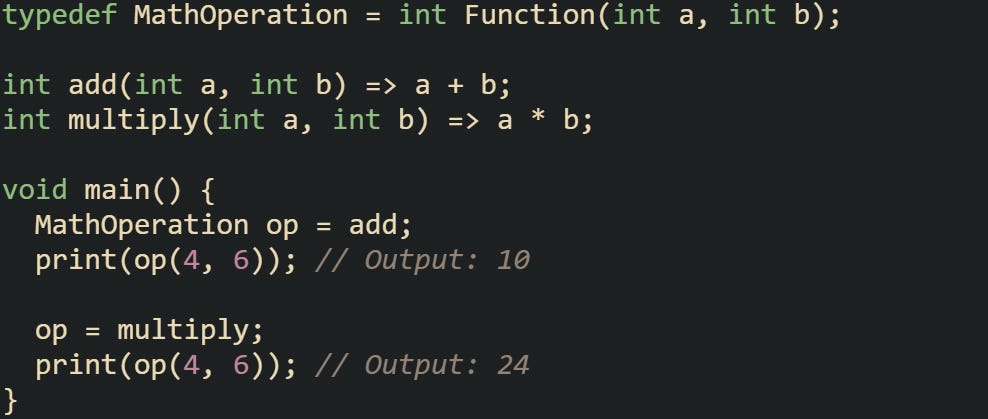
That small line defining MathOperation saves a lot of repetition. Instead of repeating the same int Function(int, int) type in several spots, the typedef keeps the meaning consistent and easier to scan. The compiler treats it exactly like a function type, so there’s no runtime overhead.
Typedefs can also be used with more descriptive names that clarify intent rather than function mechanics.
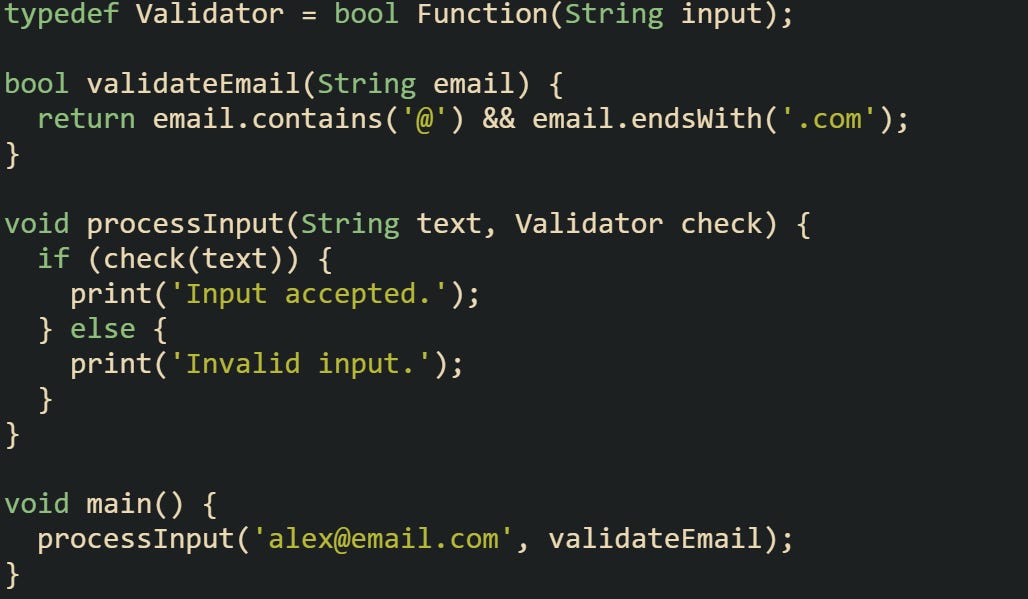
The typedef Validator expresses the idea behind the function rather than its mechanics. It represents a check or validation process in a way that makes the purpose easy to read while keeping the actual type precise and consistent within the code.
Using Typedefs for Callbacks
Callbacks are one of the most common uses for typedefs. They help separate control flow from behavior, which is why they appear so frequently in Dart frameworks and Flutter widgets. When callbacks share similar shapes, typedefs remove the visual noise of long signatures and clarify expectations at a glance.
The small example below defines a typedef for a callback that returns no value, often called a void callback.
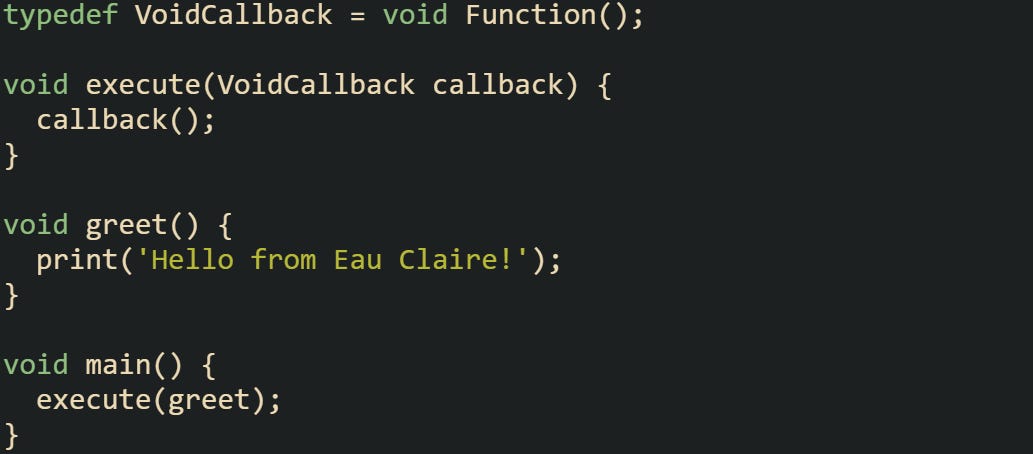
VoidCallback is simple but effective. It defines an action type that returns nothing, matching functions used to signal that something occurred without passing data back. This pattern appears frequently in UI frameworks where user actions like tapping or pressing a button trigger handlers that don’t return results.
Callbacks can also carry parameters. Here’s an example where the callback expects a string, used to process a message before it’s printed.
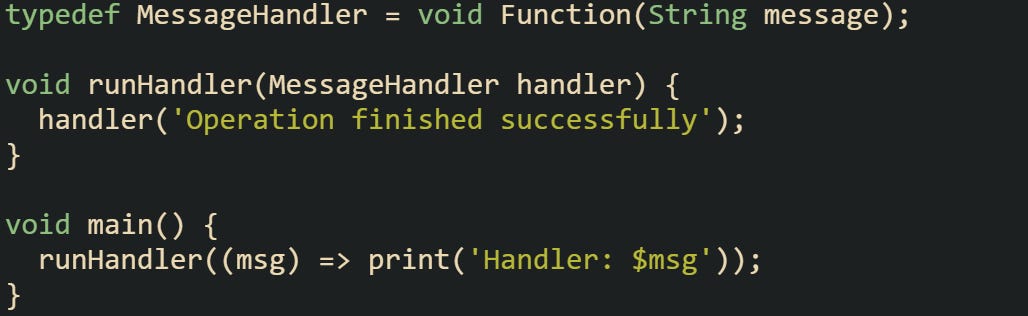
This structure works well in larger projects that rely on asynchronous updates or event-based logic, where consistent callback shapes make the system easier to extend without rewriting method definitions. Typedefs keep the behavior uniform while letting developers define intent through descriptive names.
Why Function Typedefs Help
Function typedefs help code feel more organized. When several functions share the same parameter list and return type, a typedef captures that shape once and gives it a name that makes sense for the project. That name becomes a signal of purpose, not just a shorthand for syntax.
One major advantage is that typedefs improve type safety. The compiler can check that every assigned function or callback matches the typedef signature exactly. That helps catch mismatched types early in development instead of letting errors surface at runtime. Another reason they’re helpful is that typedefs make APIs more approachable to other developers. Seeing a name like ErrorHandler or DataParser tells you what kind of function is expected before reading the full signature. It also helps when code completion tools display those names, providing more meaningful hints than generic function declarations.
This uses typedefs to manage an event system with predictable signatures:
![typedef EventCallback = void Function(String event); typedef ErrorHandler = void Function(Object error); class EventBus { final List<EventCallback> _listeners = []; final List<ErrorHandler> _errorHandlers = []; void addListener(EventCallback listener) => _listeners.add(listener); void addErrorHandler(ErrorHandler handler) => _errorHandlers.add(handler); void emit(String event) { for (var listener in _listeners) { try { listener(event); } catch (error) { for (var handler in _errorHandlers) { handler(error); } } } } } void main() { final bus = EventBus(); bus.addListener((event) => print('Received: $event')); bus.addErrorHandler((error) => print('Error: $error')); bus.emit('System started'); }](https://substackcdn.com/image/fetch/$s_!_535!,f_auto,q_auto:good,fl_progressive:steep/https%3A%2F%2Fsubstack-post-media.s3.amazonaws.com%2Fpublic%2Fimages%2Fb9cc6b26-9261-4939-89b8-b25e10b548b9_1077x870.png "typedef EventCallback = void Function(String event); typedef ErrorHandler = void Function(Object error); class EventBus { final List<EventCallback> _listeners = []; final List<ErrorHandler> _errorHandlers = []; void addListener(EventCallback listener) => _listeners.add(listener); void addErrorHandler(ErrorHandler handler) => _errorHandlers.add(handler); void emit(String event) { for (var listener in _listeners) { try { listener(event); } catch (error) { for (var handler in _errorHandlers) { handler(error); } } } } } void main() { final bus = EventBus(); bus.addListener((event) => print('Received: $event')); bus.addErrorHandler((error) => print('Error: $error')); bus.emit('System started'); }")
Typedefs in this example make it obvious which functions belong to normal events and which handle errors. Without typedefs, the parameter lists would need to be repeated throughout the code, making maintenance more difficult.
Function typedefs aren’t limited to small callbacks. They become even more valuable in large applications, where they define consistent shapes for handlers, validators, formatters, and other repeated structures. They make type information more human-friendly without sacrificing Dart’s static typing benefits.
Generic Function Type Aliases
Generic function typedefs expand what regular typedefs can do by adding type parameters. They let developers define flexible and reusable function signatures that adapt to multiple data types. Instead of being locked to a single concrete type, a generic typedef describes a whole category of functions that share the same structure but work with different inputs or outputs. This makes them valuable in situations where behavior is consistent but the data varies, such as with collections, transformations, or processing pipelines.
These typedefs not only reduce repetition but also bring type safety to reusable components that depend on functions. They work hand in hand with Dart’s type system, catching mismatched types at compile time while keeping the code expressive and easy to read.
Declaring a Generic Function Typedef
A generic function typedef introduces a type parameter using angle brackets, similar to how generic classes or methods do. It allows one definition to cover multiple type scenarios, which keeps code reusable and easier to maintain when multiple types follow the same logic.
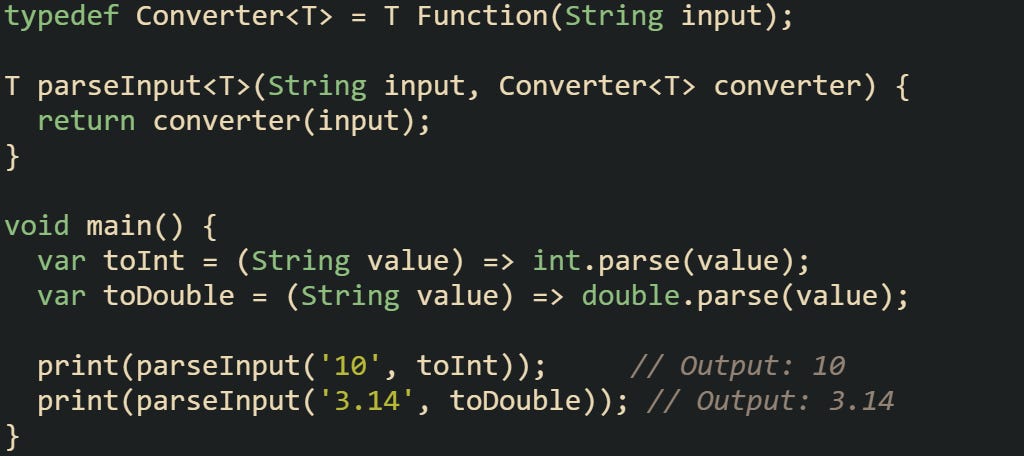
The typedef Converter<T> defines a single reusable function structure. It tells Dart that any function matching T Function(String) can act as a converter for different target types. This removes the need to redefine new function signatures for every type of conversion.
Sometimes, generic typedefs also make intent clearer when working with APIs that need callbacks for various data transformations. For example, a Mapper<T, R> typedef can describe a function that maps one type to another.
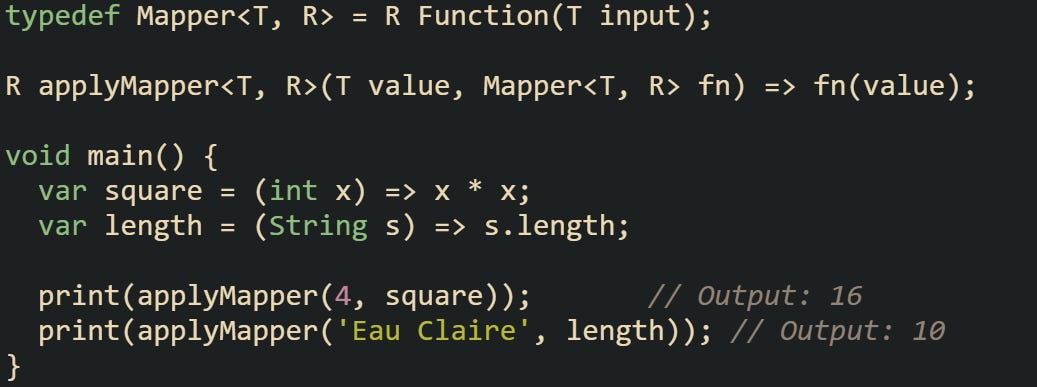
This generic typedef defines a pattern for transforming data from one type to another, giving more flexibility without writing separate methods for each case. It also keeps function contracts consistent across various type combinations.
Type Aliases for Complex Generics
In larger projects, type definitions can grow complicated when dealing with nested collections or higher-order functions. Generic typedefs give developers a way to shorten these long declarations and make them approachable.
Let’s say we have a application that processes lists of values and filters them based on custom conditions. A generic typedef can represent any function that decides whether a given element passes a filter.
![typedef Filter<T> = bool Function(T value); List<T> applyFilter<T>(List<T> items, Filter<T> test) { var results = <T>[]; for (var item in items) { if (test(item)) { results.add(item); } } return results; } void main() { var numbers = [10, 15, 22, 33, 40]; var evenFilter = (int n) => n % 2 == 0; var filtered = applyFilter(numbers, evenFilter); print(filtered); // Output: [10, 22, 40] }](https://substackcdn.com/image/fetch/$s_!yKXA!,f_auto,q_auto:good,fl_progressive:steep/https%3A%2F%2Fsubstack-post-media.s3.amazonaws.com%2Fpublic%2Fimages%2F8cb1db1a-a532-431e-9180-ca3416537694_1038x629.png "typedef Filter<T> = bool Function(T value); List<T> applyFilter<T>(List<T> items, Filter<T> test) { var results = <T>[]; for (var item in items) { if (test(item)) { results.add(item); } } return results; } void main() { var numbers = [10, 15, 22, 33, 40]; var evenFilter = (int n) => n % 2 == 0; var filtered = applyFilter(numbers, evenFilter); print(filtered); // Output: [10, 22, 40] }")
Filter<T> represents a logical condition that can apply to any type. That simple alias saves time when the same function shape appears across multiple modules or data layers. It also communicates purpose immediately, making the function contracts easier to follow.
Generic typedefs also work well when combining functions that transform or combine data. Suppose a developer wants to define a function type that merges two objects of the same type into one result.
![typedef Combiner<T> = T Function(T a, T b); T reduceList<T>(List<T> items, Combiner<T> combine) { var result = items.first; for (var i = 1; i < items.length; i++) { result = combine(result, items[i]); } return result; } void main() { var words = ['Hello', 'World', 'from', 'Wisconsin']; var combined = reduceList(words, (a, b) => '$a $b'); print(combined); // Output: Hello World from Wisconsin }](https://substackcdn.com/image/fetch/$s_!Xgcx!,f_auto,q_auto:good,fl_progressive:steep/https%3A%2F%2Fsubstack-post-media.s3.amazonaws.com%2Fpublic%2Fimages%2F1a488f2b-4c59-468f-812c-793c03c7a103_1035x523.png "typedef Combiner<T> = T Function(T a, T b); T reduceList<T>(List<T> items, Combiner<T> combine) { var result = items.first; for (var i = 1; i < items.length; i++) { result = combine(result, items[i]); } return result; } void main() { var words = ['Hello', 'World', 'from', 'Wisconsin']; var combined = reduceList(words, (a, b) => '$a $b'); print(combined); // Output: Hello World from Wisconsin }")
This typedef describes a function that merges two values into one. Because it’s generic, the same structure works for strings, numbers, or even custom objects without any extra definitions.
Type Aliases vs Class Based Function Objects
Before Dart improved typedef support, developers sometimes relied on abstract classes to define callable behaviors. A class could define a call() method, letting its instances behave like functions. While still valid, this approach adds extra structure that typedefs can now replace with less code and better readability.
Here’s how an older class-based callable can look:
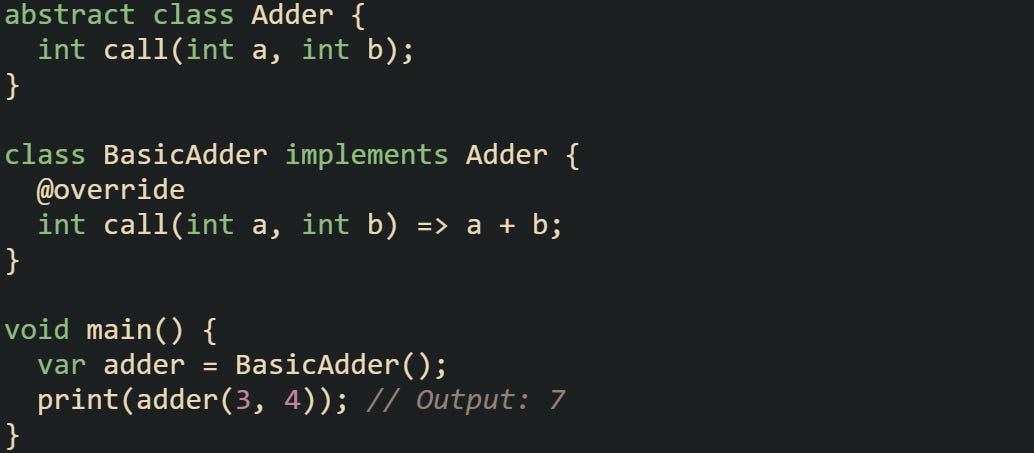
This works but creates unnecessary boilerplate for something that can be expressed in one line with a typedef.
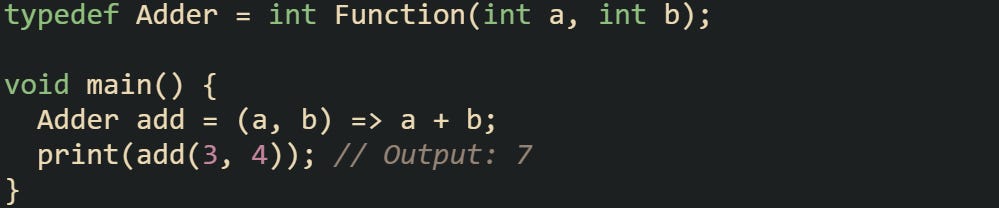
Function typedefs achieve the same effect without the overhead of a class declaration. They also integrate better with Dart’s type inference, allowing inline function literals to match the typedef automatically.
Still, callable classes remain valuable in cases where behavior carries state or requires inheritance. Typedefs shine in defining reusable function contracts, while callable classes are better for behaviors that combine data and logic.
Differences Between Function Typedefs and Type Aliases
Dart uses typedef to declare type aliases. A type alias can refer to any existing type, including function types, collections, maps, and custom classes, so there is no separate type keyword in the language. You can use type aliases both for callable shapes and for non-function types, depending on what you want to express.

This pair shows Formatter<T> as a reusable function type and StringList as an alias for a specific kind of list. Both improve readability, but Formatter<T> describes a callable structure while StringList describes a data structure. A helpful way to think about it is that a function-shaped alias answers the question, “What kind of function is this?” while a non-function alias answers, “What kind of data is this?” Both keep large Dart codebases easier to read and work with.
Conclusion
Typedefs and type aliases give Dart a structured way to describe how functions and data types behave. They let developers express complex function signatures with names that make sense, keeping intent visible without cluttering the code. Generic function typedefs build on that idea by letting the same structure handle different data types while keeping type safety intact. These features help Dart code stay readable, consistent, and precise when defining behaviors that repeat across projects.